Tosca, Dutch National Opera, 18.09.2025
My hands, as usual, were covered in cornstarch powder from the gloves I wore to dish out meals at the soup kitchen. After closing, the volunteers gathered together for tea. But I had made a point of leaving earlier that evening, in order to get back to my five month old puppy, Napoleonpatiently waiting for me at home.
Rushing to make the pedestrian light to cross the road to my bicycle, I was rubbing my hands up and down the sides of my beige coat when I heard a smooth baritone call out to me in a sultry, southern drawl:
‘Excuse me, miss, you wouldn’t happen to know where the opera house is, would you?’
I whipped around, stepping back from the street ‘It’s right here,’ I said, pointing to the building directly in front of us. The soup kitchen was behind the opera house.
‘Oh is that it?’ He asked, slowly.
‘Yes!’ I made my way toward the street again.
‘And —’
I stopped to listen, turning around once more.
‘Would you happen to be free tonight?’
‘I was just making my way home,’ I replied. ‘Why?’
‘I’ve got two tickets to an opera whose name I can’t even pronounce, and my date cancelled on me at the last minute,” he said. ‘They’re good tickets too, and it would be a damn shame for one of them to go to waste.’
I looked him over skeptically, heart pounding. What luck, what terrifying luck! I thought to myself. It couldn’t be true. Some trick must be lying in store, some bad turn of fate. Maybe he was planning on pickpocketing me: I had just been pickpocketed in London that may, wearing exactly the same coat. But then I remembered that I didn’t have my wallet with me. Next possibility: maybe the opera was terrible, something hopelessly experimental with a libretto written in computer code composed by someone who hated music. I had not been keeping up with the season’s program, so I didn’t know what was playing. ‘What’s the opera?’ I asked.
‘It starts with a T,’ he said.
‘Tosca?’ I asked, brimming with excitement.
He smiled. ‘I think that’s the one.’
Puccini’s Tosca. Premiered in 1900 and one of the most popular operas of all time, featuring ‘Vissi d’arte’, one of the greatest arias of all time. The last performance I had seen was at the Met in 2013, directed by Luc Bondy. I had paid 160 dollars for a partial view balcony seat. I remembered the enormous canvas of Mary Magdalene with one breast exposed, which the painter Cavaradossi climbed up and down a scaffold to paint. I remembered his jealous lover, the singer Tosca, and her scarlet dress, and the wood-paneled office wherein she eventually stabbed the Chief of Police Scarpia, who was holding Cavaradossi prisoner.
The opera left little impression on me. It would be unfair for me to judge the performances twelve years after the fact. If I remember them as stiff, it may only be because I had to sit so stiffly in my shaky bar stool in order to keep my balance, all while straining to get a glimpse of the stage beyond the massive column obstructing our view. I spent most of the evening stupified by the fact that the Met had charged me so much for such a terrible seat. I had just turned twenty-one years old and didn’t get what the fuss was about. Opportunities came and went to see Tosca again, but I never took them.
And yet here I was, twelve years later, being offered a free ticket to Tosca on the street by a stranger. I shifted my weight from one foot to another, remembering my new dog and the terrible events which transpired after seeing Peter Grimes the year prior (read my review if you haven’t already).
‘I have a puppy at home,’ I said. ‘He’s been home alone for an hour. I should really get back.’
‘Aw, you have a dog?’ He said. ‘I have one too, look.’ He whipped out his phone and showed me his wallpaper with what looked like a black lab mix. In an instant my wariness subsided. ‘How long can your dog be alone for?’
I hesitated. The truth was, Napoleon was much calmer than my previous dog and was already used to being alone for longer stints of time. ‘I guess I could come to the first act,’ I said. ‘But I really have to leave at intermission.’
‘Awesome’ he said. We made our way to the opera house. He told me he was from Louisiana and was in Europe for dirt-biking. He had just been dirt-biking in Albania, and was passing through Amsterdam before heading to Denmark.
‘Are you a regular opera goer?’ I asked. I hadn’t met many dirt-bikers, maybe the activities went hand in hand.
‘Nah,’ he said. ‘This is my first time.’ While running that morning an Italian aria had come on the Spotify channel he had been listening to and its beauty blew him away. ‘I just googled ‘Opera Amsterdam’ and booked this right away.’
I asked him why his date had cancelled.
‘I met her on an app and invited her to join,’ he said. ‘She said yes, but then after I bought the tickets she just went quiet.’
I sighed, shaking my head. It was a familiar story.
As we entered through the doors of the huge, brick-UFO of an opera house, colloquially referred to as the ‘Stopera’ by Amsterdammers, short for ’Stop the Opera’ and used to protest the building’s construction in the 1980s, I said a little prayer: Dear God, please do not let this man’s first opera experience be so terrible that he never returns. Pietà! Have Mercy!
We collected the tickets at the ticket booth and made our way to our seats. They really were outstanding. ‘Whoever ghosted you is an idiot,’ I said. He smiled. ‘Do you like opera?’
After taking off my coat and thanking God for not having permitted me to wear my usual heinous uniform to the soup kitchen that night (I was wearing at least, a form-fitting dress with black flats), I turned to him with a big grin. ‘Like it? I love the opera. I’m an amateur opera singer myself.’
The show we were seeing was a revival of Barrie Kosky’s 2022 production with set designs by Rufus Didwiszus. The first disappointment was Cavaradossi’s (Joshua Guerrero) obviously empty canvas in the first scene in his studio. Would it have been so difficult to print an image on it, so that when Tosca (Natalya Romaniw) storms in in a jealous rage about the depicted woman ostensibly resembling the Marchesa, we might believe her?
I like to think of such production pitfalls as hurdles which only strong performers can heroically leap over without losing the audience. Romaniw and Guerrero’s chemistry on stage was so palpable my eyes rested on the canvas for only a fraction of a second; meanwhile Tosca’s blue dress (costumes by Klaus Bruns), with a sweeping, swirling skirt, easily distracted one’s gaze from the fact that Cavaradossi was apparently busy painting nothing.
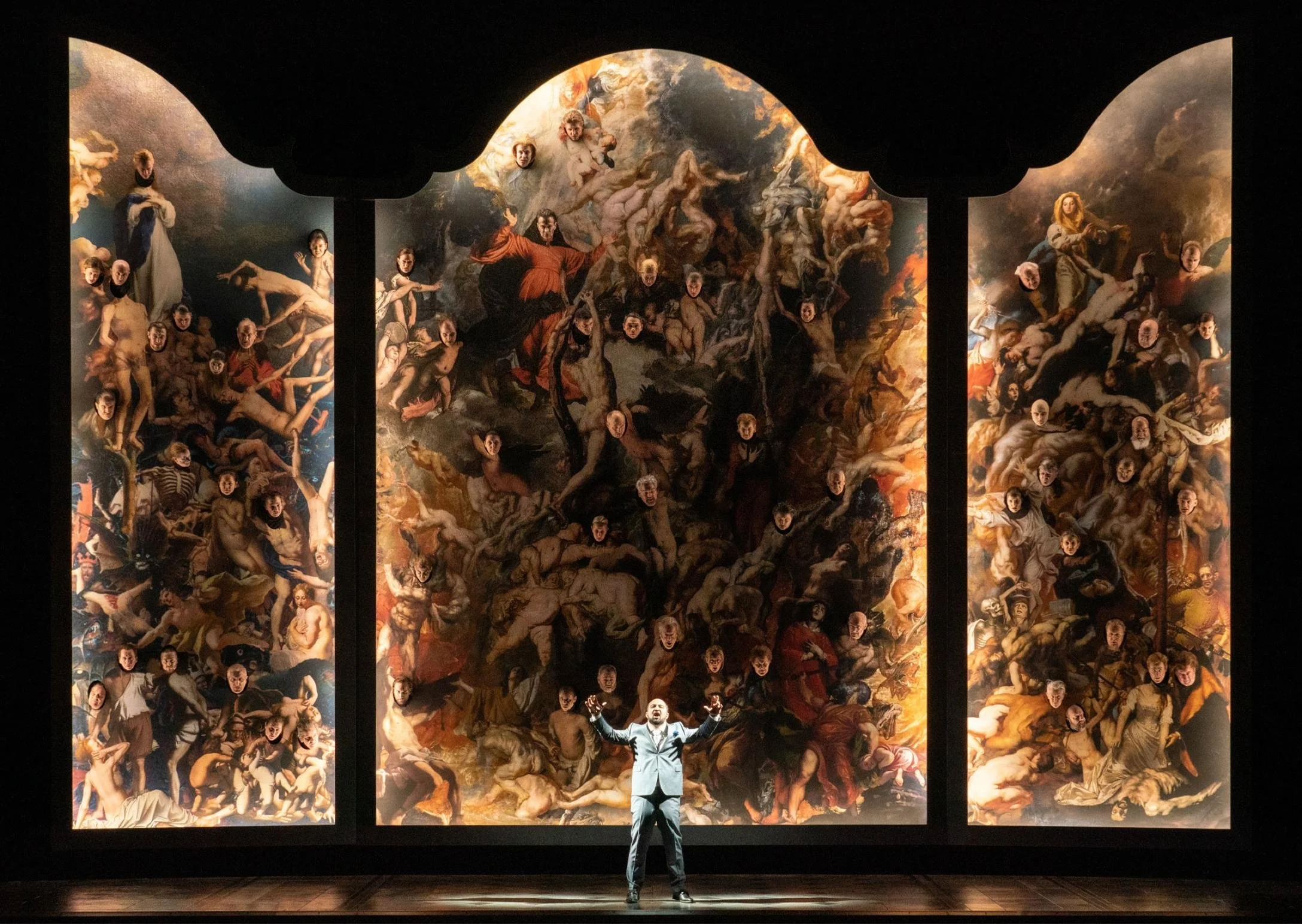
Scarpia (Gevorg Hakobyan) sings ‘Te Deum’ at the end of Act I. Photo by Marco Borggreve. Via https://www.operaballet.nl/en/dutch-national-opera/2025-2026/tosca
Eclipsing all else in Act 1 was the closing scene with Scarpia’s (Gevorg Hakobyan) aria ‘Te Deum’, in which, galvanized by false reports of Napoleon’s defeat at battle, he professes his plan to seduce Tosca and execute her republican lover. A gargantuan triptych emerged from the darkness (lighting Franck Evin) behind him, featuring a painting of the Last Judgment. Choristers’ heads jutted out through holes in the triptych attached to muscular bodies painted descending into hell or being lifted into heaven, singing the first lines of the Latin hymn ‘Te Deum’ (‘we praise thee, O God…all the earth doth worship thee’) as part of a mad fantasy clearly in Scarpia’s mind. In more traditional stagings, Scarpia is in church while the hymn is being sung; hearing it stirs him from his dark machinations: ‘Tosca, mi fai dimenticare Iddio!’ (Tosca, you make me forget God) he cries out, before genuflecting in prayer. Whereas a staging in church leaves some room for doubt as to whether Scarpia will submit to his temptation, Kosky’s Last Judgment scenery suggests he is already so far-gone his fate has been decided. As soon as the curtain fell on Scarpia, his hands outstretched toward the heavens from his lowly place in hell, I knew I would stay for the second act.
I was moved by Kasper Holten’s psychological production of Mozart’s Don Giovanni for the Royal Opera House in 2014, in which the set was made up of the many rooms of Don Giovanni’s mind, walls covered in scrawled names of the countless women he had seduced. Kosky’s staging of ‘Te Deum’ brought me back to it and I hoped there would be more creative, psychologically-loaded surprises in Act II. But most of Act II ended up taking place in a starkly grey, modern kitchen dominated by a cement island the size of a submarine. Scarpia sat, for the most part, at the far end of the island near the fridge in a black t-shirt, drinking red wine, while his suit-donning cronies were crowded uncomfortably behind the island, as if they were all waiters who had suddenly been tasked with replacing the chefs at a restaurant and were at a loss as to where to begin. Meanwhile Cavadarossi was being tortured in the cellar below; the suits would climb up and down a ladder to him, returning to the kitchen covered in ever more blood. When news arrives the Napoleon actually was victorious at battle, Cavadarossi’s shouts of Vittoria! compel Scarpia to demand his immediate execution.
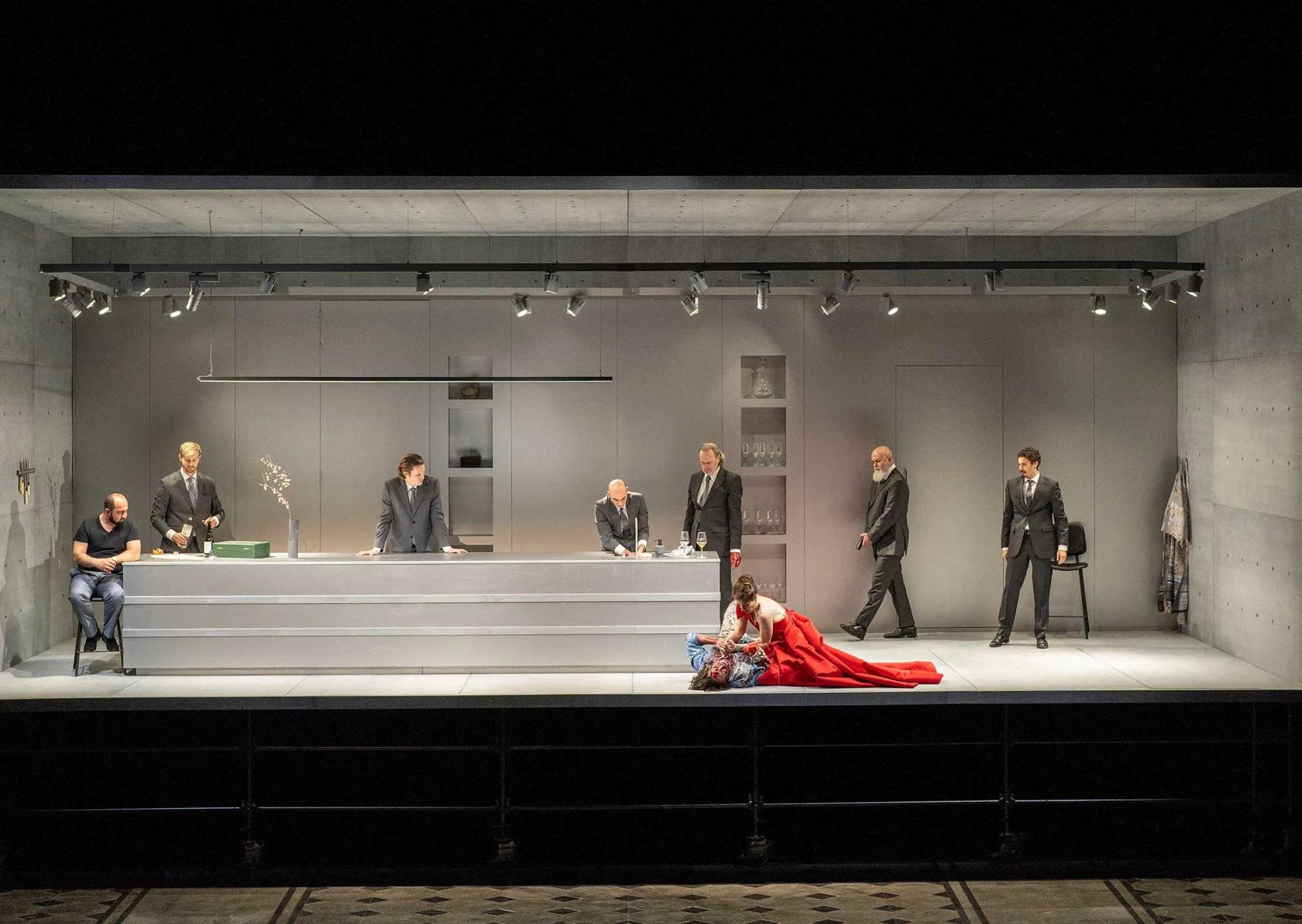
‘No. More. Cassoulet!’ Tosca seems to say. Photo by Marco Borggreve via https://www.operaballet.nl/en/dutch-national-opera/2025-2026/tosca
Perhaps Kosky was using the kitchen interior to help housewives in the audience relate to the glamorous Tosca. Fearful of Cavadarossi’s fate, Tosca finally agrees to give herself to Scarpia after singing ‘Vissi d’Arte’ (I lived for art, I lived for love, I never hurt a living being). Rather than being a final plea to God to save her virtue, Vissi d’arte became, in Kosky’s version, a eulogy for the housewife’s abandoned pursuits. That, at least, was the drama suggested to me by the evening’s performance, not by any fault of the performer but because Romaniw was so confined between the gargantuan kitchen island and the wall of the set. When she finally stabbed Scarpia in a crab-like embrace on top of the island, the shock was quickly supplanted by relief: she was going to leave this tasteless, industrial kitchen, and have more room to swirl around in that red dress of hers.
All of Puccini’s women are made to suffer, and most of them die. “I act as executioner to these poor frail creatures,” he once wrote to a friend. “The Neronian instinct manifests and fulfills itself.”
In Act III, Tosca hopes Cavaradossi will be saved. Then she watches him die by firing squad, and soon thereafter jumps to her own death to escape arrest for murdering Scarpia. The curtain falls. All that blood, and for what?
In spite of being one of the most popular operas of all time, Tosca and its composer have endured harsh criticism. ‘Puccini’, the conductor Toscanini once remarked, ‘was very clever, but only clever’. American musicologist Joseph Kerman famously referred to Tosca as a ‘shabby little shocker’. Of course, Kerman was comparing Puccini to Wagner and that isn’t really fair. They belong, after all, to utterly different operatic styles: Wagner was composing Germanic operas about mythical people with plots steeped in symbolism, while Puccini’s Tosca is a prime example of the Italian verismo style, capturing real people in real, if intensely dramatized, situations.
It is within the confines of this genre that Kosky’s production — with its oerebrally-staged Last Judgment and oversized kitchen island — comes together to support the realism which gives Tosca its punch. History and myth, are banal. The esteemed conqueror (Napoleon) for whom Cavaradossi dies is never seen and far away, while the institutions who kill him (Scarpia, and the Church who helps him) are corrupt. The only thing in life , Puccini’s opera seems to say, is our feelings as they are expressed in art itself (Vissi d’arte). It dies with Tosca. This is verismo at its precipice: with Tosca’s leap to the death the genre catapults itself into pure decadence.
Twenty years after writing Tosca, Puccini wrote to his librettist, ‘Almighty God touched me with His little finger and said: “Write for the theatre — mind, only for the theatre.” And I have obeyed the supreme command.’ If only we could say the same of Wagner: heaven knows what Bayreuth could be now, had he not been so hell-bent on his revolutionary and anti-semitic extracurriculars? When the curtain fell I nodded my gratitude to that Almighty God for understanding that sometimes. ‘shabby little shockers’ are all we need. After one year away from the opera, I was gripped again.
I thanked the kind stranger, then ran home to Napoleon.
