Tosca, Dutch National Opera, 18.09.2025
My hands, as usual, were covered in cornstarch powder from the gloves I wore to dish out meals at the soup kitchen. After closing, the volunteers gathered together for tea. But I had made a point of leaving earlier that evening, in order to get back to my five month old puppy, Napoleon, patiently waiting for me at home.
Rushing to make the pedestrian light to cross the road to my bicycle, I was rubbing my hands up and down the sides of my beige coat when I heard a smooth baritone call out to me in a sultry, southern drawl:
‘Excuse me, miss, you wouldn’t happen to know where the opera house is, would you?’
I whipped around, stepping back from the street ‘It’s right here,’ I said, pointing to the building directly in front of us. The soup kitchen was behind the opera house.
‘Oh is that it?’ He asked, slowly.
‘Yes!’ I made my way toward the street again.
‘And —’
I stopped to listen, turning around once more.
‘Would you happen to be free tonight?’
‘I was just making my way home,’ I replied. ‘Why?’
‘I’ve got two tickets to an opera whose name I can’t even pronounce, and my date cancelled on me at the last minute,” he said. ‘They’re good tickets too, and it would be a damn shame for one of them to go to waste.’
I looked him over skeptically, heart pounding. What luck, what terrifying luck! I thought to myself. It couldn’t be true. Some trick must be lying in store, some bad turn of fate.
Perhaps he was planning on pickpocketing me: I had just been pickpocketed in London that may, wearing exactly the same coat. But then I remembered that I didn’t have my wallet with me. Next possibility: maybe the opera was terrible, something hopelessly experimental with a libretto written in computer code composed by someone who hated music. I had not been keeping up with the season’s program, so I didn’t know what was playing. ‘What’s the opera?’ I asked.
‘It starts with a T,’ he said.
‘Tosca?’ I asked, brimming with excitement.
He smiled. ‘I think that’s the one.’
My hands, as usual, were covered in cornstarch powder from the gloves I wore to dish out meals at the soup kitchen. After closing, the volunteers gathered together for tea. But I had made a point of leaving earlier that evening, in order to get back to my five month old puppy, Napoleonpatiently waiting for me at home.
Rushing to make the pedestrian light to cross the road to my bicycle, I was rubbing my hands up and down the sides of my beige coat when I heard a smooth baritone call out to me in a sultry, southern drawl:
‘Excuse me, miss, you wouldn’t happen to know where the opera house is, would you?’
I whipped around, stepping back from the street ‘It’s right here,’ I said, pointing to the building directly in front of us. The soup kitchen was behind the opera house.
‘Oh is that it?’ He asked, slowly.
‘Yes!’ I made my way toward the street again.
‘And —’
I stopped to listen, turning around once more.
‘Would you happen to be free tonight?’
‘I was just making my way home,’ I replied. ‘Why?’
‘I’ve got two tickets to an opera whose name I can’t even pronounce, and my date cancelled on me at the last minute,” he said. ‘They’re good tickets too, and it would be a damn shame for one of them to go to waste.’
I looked him over skeptically, heart pounding. What luck, what terrifying luck! I thought to myself. It couldn’t be true. Some trick must be lying in store, some bad turn of fate. Maybe he was planning on pickpocketing me: I had just been pickpocketed in London that may, wearing exactly the same coat. But then I remembered that I didn’t have my wallet with me. Next possibility: maybe the opera was terrible, something hopelessly experimental with a libretto written in computer code composed by someone who hated music. I had not been keeping up with the season’s program, so I didn’t know what was playing. ‘What’s the opera?’ I asked.
‘It starts with a T,’ he said.
‘Tosca?’ I asked, brimming with excitement.
He smiled. ‘I think that’s the one.’
Puccini’s Tosca. Premiered in 1900 and one of the most popular operas of all time, featuring ‘Vissi d’arte’, one of the greatest arias of all time. The last performance I had seen was at the Met in 2013, directed by Luc Bondy. I had paid 160 dollars for a partial view balcony seat. I remembered the enormous canvas of Mary Magdalene with one breast exposed, which the painter Cavaradossi climbed up and down a scaffold to paint. I remembered his jealous lover, the singer Tosca, and her scarlet dress, and the wood-paneled office wherein she eventually stabbed the Chief of Police Scarpia, who was holding Cavaradossi prisoner.
The opera left little impression on me. It would be unfair for me to judge the performances twelve years after the fact. If I remember them as stiff, it may only be because I had to sit so stiffly in my shaky bar stool in order to keep my balance, all while straining to get a glimpse of the stage beyond the massive column obstructing our view. I spent most of the evening stupified by the fact that the Met had charged me so much for such a terrible seat. I had just turned twenty-one years old and didn’t get what the fuss was about. Opportunities came and went to see Tosca again, but I never took them.
And yet here I was, twelve years later, being offered a free ticket to Tosca on the street by a stranger. I shifted my weight from one foot to another, remembering my new dog and the terrible events which transpired after seeing Peter Grimes the year prior (read my review if you haven’t already).
‘I have a puppy at home,’ I said. ‘He’s been home alone for an hour. I should really get back.’
‘Aw, you have a dog?’ He said. ‘I have one too, look.’ He whipped out his phone and showed me his wallpaper with what looked like a black lab mix. In an instant my wariness subsided. ‘How long can your dog be alone for?’
I hesitated. The truth was, Napoleon was much calmer than my previous dog and was already used to being alone for longer stints of time. ‘I guess I could come to the first act,’ I said. ‘But I really have to leave at intermission.’
‘Awesome’ he said. We made our way to the opera house. He told me he was from Louisiana and was in Europe for dirt-biking. He had just been dirt-biking in Albania, and was passing through Amsterdam before heading to Denmark.
‘Are you a regular opera goer?’ I asked. I hadn’t met many dirt-bikers, maybe the activities went hand in hand.
‘Nah,’ he said. ‘This is my first time.’ While running that morning an Italian aria had come on the Spotify channel he had been listening to and its beauty blew him away. ‘I just googled ‘Opera Amsterdam’ and booked this right away.’
I asked him why his date had cancelled.
‘I met her on an app and invited her to join,’ he said. ‘She said yes, but then after I bought the tickets she just went quiet.’
I sighed, shaking my head. It was a familiar story.
As we entered through the doors of the huge, brick-UFO of an opera house, colloquially referred to as the ‘Stopera’ by Amsterdammers, short for ’Stop the Opera’ and used to protest the building’s construction in the 1980s, I said a little prayer: Dear God, please do not let this man’s first opera experience be so terrible that he never returns. Pietà! Have Mercy!
We collected the tickets at the ticket booth and made our way to our seats. They really were outstanding. ‘Whoever ghosted you is an idiot,’ I said. He smiled. ‘Do you like opera?’
After taking off my coat and thanking God for not having permitted me to wear my usual heinous uniform to the soup kitchen that night (I was wearing at least, a form-fitting dress with black flats), I turned to him with a big grin. ‘Like it? I love the opera. I’m an amateur opera singer myself.’
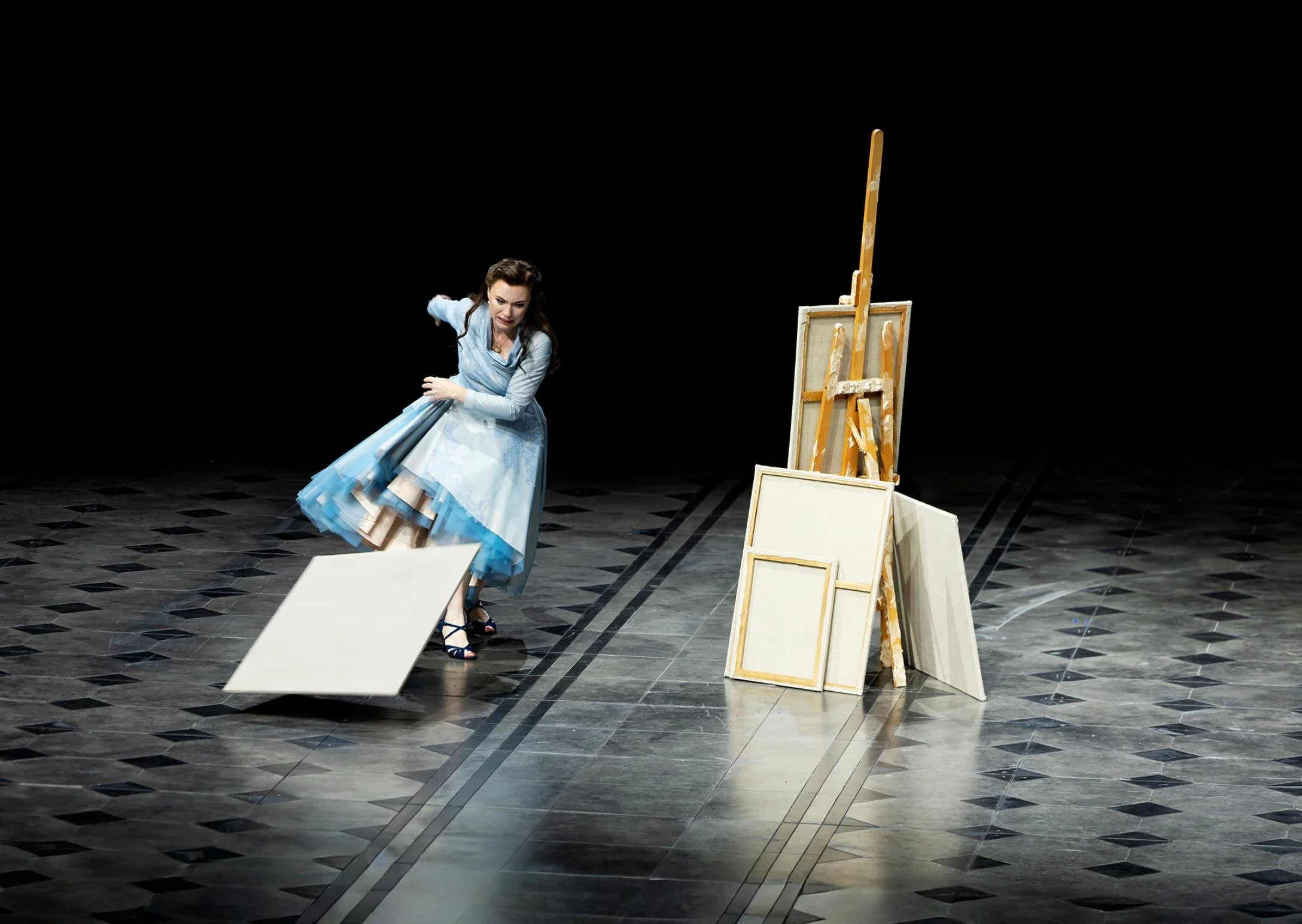
The show we were seeing was a revival of Barrie Kosky’s 2022 production with set designs by Rufus Didwiszus. The first disappointment was Cavaradossi’s (Joshua Guerrero) obviously empty canvas in the first scene in his studio. Would it have been so difficult to print an image on it, so that when Tosca (Natalya Romaniw) storms in in a jealous rage about the depicted woman ostensibly resembling the Marchesa, we might believe her?
I like to think of such production pitfalls as hurdles which only strong performers can heroically leap over without losing the audience. Romaniw and Guerrero’s chemistry on stage was so palpable my eyes rested on the canvas for only a fraction of a second; meanwhile Tosca’s blue dress (costumes by Klaus Bruns), with a sweeping, swirling skirt, easily distracted one’s gaze from the fact that Cavaradossi was apparently busy painting nothing.
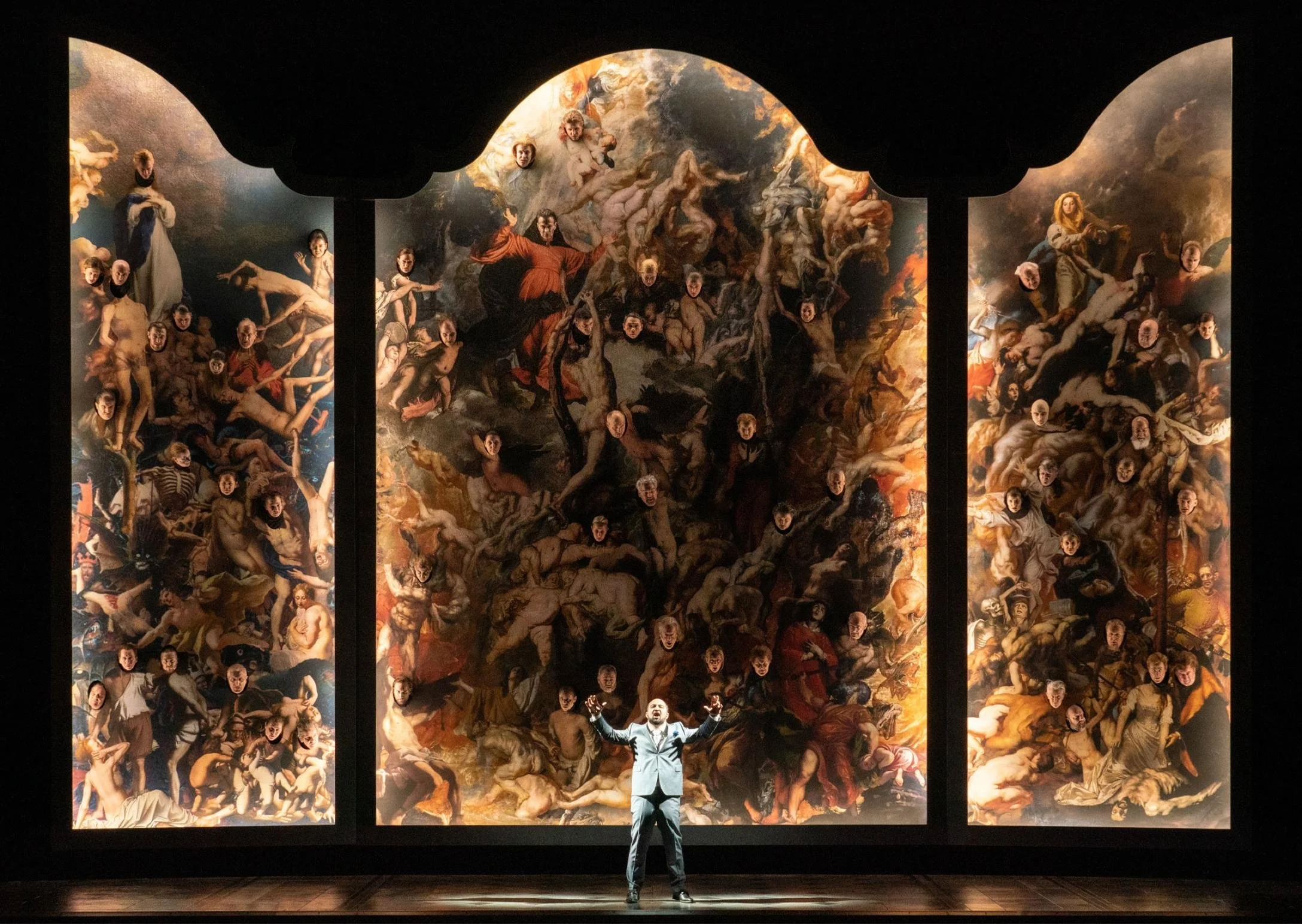
Scarpia (Gevorg Hakobyan) sings ‘Te Deum’ at the end of Act I. Photo by Marco Borggreve. Via https://www.operaballet.nl/en/dutch-national-opera/2025-2026/tosca
Eclipsing all else in Act 1 was the closing scene with Scarpia’s (Gevorg Hakobyan) aria ‘Te Deum’, in which, galvanized by false reports of Napoleon’s defeat at battle, he professes his plan to seduce Tosca and execute her republican lover. A gargantuan triptych emerged from the darkness (lighting Franck Evin) behind him, featuring a painting of the Last Judgment. Choristers’ heads jutted out through holes in the triptych attached to muscular bodies painted descending into hell or being lifted into heaven, singing the first lines of the Latin hymn ‘Te Deum’ (‘we praise thee, O God…all the earth doth worship thee’) as part of a mad fantasy clearly in Scarpia’s mind. In more traditional stagings, Scarpia is in church while the hymn is being sung; hearing it stirs him from his dark machinations: ‘Tosca, mi fai dimenticare Iddio!’ (Tosca, you make me forget God) he cries out, before genuflecting in prayer. Whereas a staging in church leaves some room for doubt as to whether Scarpia will submit to his temptation, Kosky’s Last Judgment scenery suggests he is already so far-gone his fate has been decided. As soon as the curtain fell on Scarpia, his hands outstretched toward the heavens from his lowly place in hell, I knew I would stay for the second act.
I was moved by Kasper Holten’s psychological production of Mozart’s Don Giovanni for the Royal Opera House in 2014, in which the set was made up of the many rooms of Don Giovanni’s mind, walls covered in scrawled names of the countless women he had seduced. Kosky’s staging of ‘Te Deum’ brought me back to it and I hoped there would be more creative, psychologically-loaded surprises in Act II. But most of Act II ended up taking place in a starkly grey, modern kitchen dominated by a cement island the size of a submarine. Scarpia sat, for the most part, at the far end of the island near the fridge in a black t-shirt, drinking red wine, while his suit-donning cronies were crowded uncomfortably behind the island, as if they were all waiters who had suddenly been tasked with replacing the chefs at a restaurant and were at a loss as to where to begin. Meanwhile Cavadarossi was being tortured in the cellar below; the suits would climb up and down a ladder to him, returning to the kitchen covered in ever more blood. When news arrives the Napoleon actually was victorious at battle, Cavadarossi’s shouts of Vittoria! compel Scarpia to demand his immediate execution.
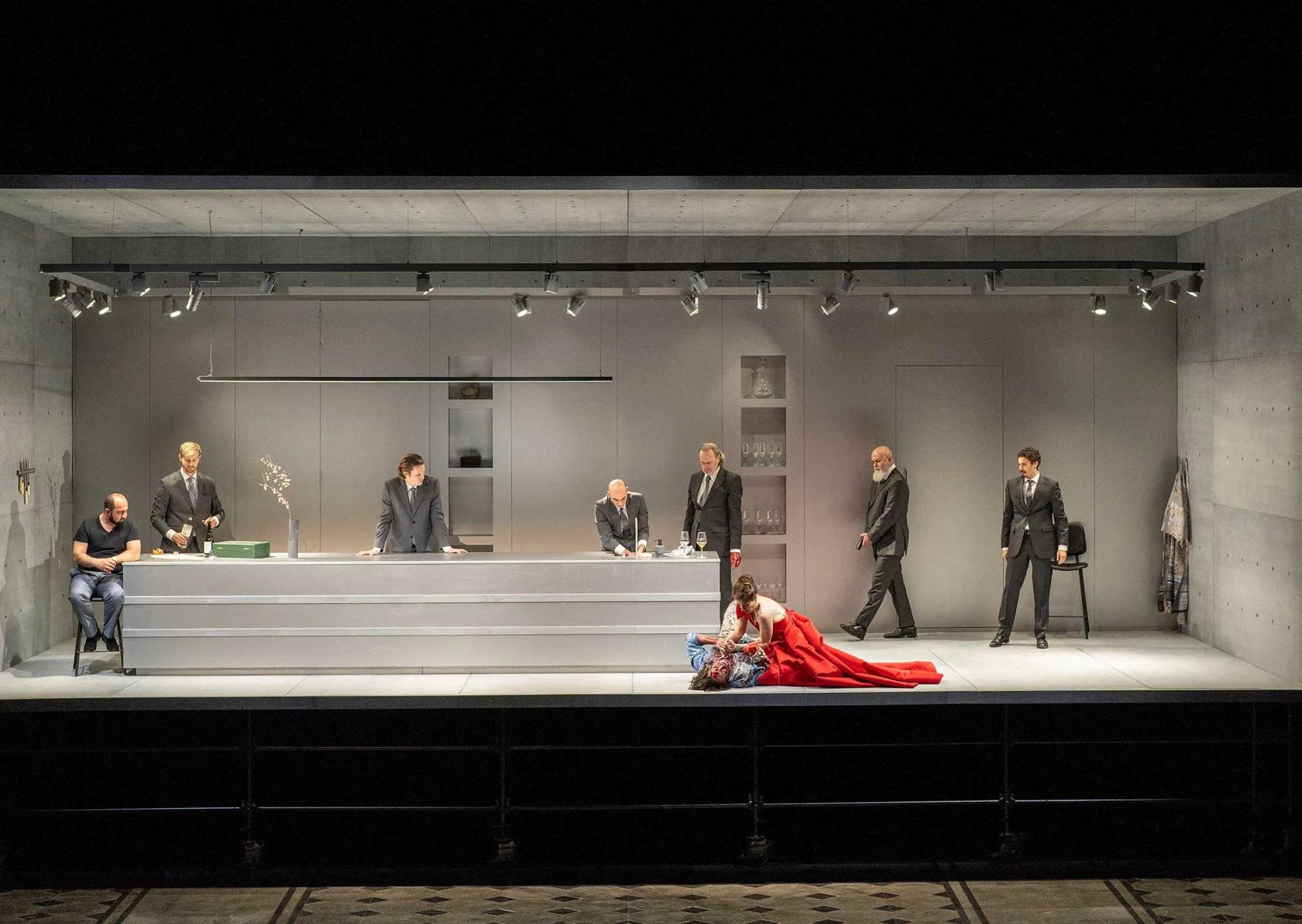
‘No. More. Cassoulet!’ Tosca seems to say. Photo by Marco Borggreve via https://www.operaballet.nl/en/dutch-national-opera/2025-2026/tosca
Perhaps Kosky was using the kitchen interior to help housewives in the audience relate to the glamorous Tosca. Fearful of Cavadarossi’s fate, Tosca finally agrees to give herself to Scarpia after singing ‘Vissi d’Arte’ (I lived for art, I lived for love, I never hurt a living being). Rather than being a final plea to God to save her virtue, Vissi d’arte became, in Kosky’s version, a eulogy for the housewife’s abandoned pursuits. That, at least, was the drama suggested to me by the evening’s performance, not by any fault of the performer but because Romaniw was so confined between the gargantuan kitchen island and the wall of the set. When she finally stabbed Scarpia in a crab-like embrace on top of the island, the shock was quickly supplanted by relief: she was going to leave this tasteless, industrial kitchen, and have more room to swirl around in that red dress of hers.
All of Puccini’s women are made to suffer, and most of them die. “I act as executioner to these poor frail creatures,” he once wrote to a friend. “The Neronian instinct manifests and fulfills itself.”
In Act III, Tosca hopes Cavaradossi will be saved. Then she watches him die by firing squad, and soon thereafter jumps to her own death to escape arrest for murdering Scarpia. The curtain falls. All that blood, and for what?
In spite of being one of the most popular operas of all time, Tosca and its composer have endured harsh criticism. ‘Puccini’, the conductor Toscanini once remarked, ‘was very clever, but only clever’. American musicologist Joseph Kerman famously referred to Tosca as a ‘shabby little shocker’. Of course, Kerman was comparing Puccini to Wagner and that isn’t really fair. They belong, after all, to utterly different operatic styles: Wagner was composing Germanic operas about mythical people with plots steeped in symbolism, while Puccini’s Tosca is a prime example of the Italian verismo style, capturing real people in real, if intensely dramatized, situations.
It is within the confines of this genre that Kosky’s production — with its oerebrally-staged Last Judgment and oversized kitchen island — comes together to support the realism which gives Tosca its punch. History and myth, are banal. The esteemed conqueror (Napoleon) for whom Cavaradossi dies is never seen and far away, while the institutions who kill him (Scarpia, and the Church who helps him) are corrupt. The only thing in life , Puccini’s opera seems to say, is our feelings as they are expressed in art itself (Vissi d’arte). It dies with Tosca. This is verismo at its precipice: with Tosca’s leap to the death the genre catapults itself into pure decadence.
Twenty years after writing Tosca, Puccini wrote to his librettist, ‘Almighty God touched me with His little finger and said: “Write for the theatre — mind, only for the theatre.” And I have obeyed the supreme command.’ If only we could say the same of Wagner: heaven knows what Bayreuth could be now, had he not been so hell-bent on his revolutionary and anti-semitic extracurriculars? When the curtain fell I nodded my gratitude to that Almighty God for understanding that sometimes. ‘shabby little shockers’ are all we need. After one year away from the opera, I was gripped again.
I thanked the kind stranger, then ran home to Napoleon.
Peter Grimes, Dutch National Opera 06.10.2024
I’m thinking of taking him to Peter Grimes’, I confided to my friend.
‘Absolutely not’, she answered. ‘No dates to the opera. It’s cursed!’
I suspected she might be right. Though you won’t find it on their website, the Dutch National Opera began as a city opera founded by a Dutch collaborator during the Nazi Occupation. The desire to have a city opera house was longstanding, but it was only under the occupying regime that the project received the attention and subsidies it needed. The Amsterdam opera company behaved most improperly during the war: their first performances were for the national socialist organization Frontzorg as well as for Vreugde en Arbeid (Joy and Labor), the Dutch equivalent of the German Freude durch Arbeit (Joy through Work). The company traveled to Salzburg at Hitler’s invitation. After the war’s end, the entire opera company was put on trial for professional collaboration with the enemy. The founder was sentenced to a five-year work ban, but the company as a whole was acquitted. The reason? Amsterdam had to have an opera house. It needed the prestige.
Maybe the decision to forgo punishment came at a slow-burning price, which only us post-war opera-lovers are expected to pay. There is, on the one hand, the very tangible tax imposed upon us through the Dutch National Opera’s impressive determination to make something both new and boring out of every pre-20th century opera. Where does this drive come from? Does it stem from the same fear of heroic grandeur we sense at Bayreuth, when Brunhilde storms out on stage wearing not a winged helmet, but bandages concealing a recent facelift? (Read Sigmund Oakeshott’s last review, if you haven’t already)
‘I’m thinking of taking him to Peter Grimes’, I confided to my friend.
‘Absolutely not’, she answered. ‘No dates to the opera. It’s cursed!’
I suspected she might be right. Though you won’t find it on their website, the Dutch National Opera began as a city opera founded by a Dutch collaborator during the Nazi Occupation. The desire to have a city opera house was longstanding, but it was only under the occupying regime that the project received the attention and subsidies it needed. The Amsterdam opera company behaved most improperly during the war: their first performances were for the national socialist organization Frontzorg as well as for Vreugde en Arbeid (Joy and Labor), the Dutch equivalent of the German Freude durch Arbeit (Joy through Work). The company traveled to Salzburg at Hitler’s invitation. After the war’s end, the entire opera company was put on trial for professional collaboration with the enemy. The founder was sentenced to a five-year work ban, but the company as a whole was acquitted. The reason? Amsterdam had to have an opera house. It needed the prestige.
Maybe the decision to forgo punishment came at a slow-burning price, which only us post-war opera-lovers are expected to pay. There is, on the one hand, the very tangible tax imposed upon us through the Dutch National Opera’s impressive determination to make something both new and boring out of every pre-20th century opera. Where does this drive come from? Does it stem from the same fear of heroic grandeur we sense at Bayreuth, when Brunhilde storms out on stage wearing not a winged helmet, but bandages concealing a recent facelift? (Read Sigmund Oakeshott’s last review, if you haven’t already)
Considering the complicated relationship with the Third Reich shared by both opera houses, I am inclined to think there is some connection. But perhaps that is wishful thinking. Dreaming up such mythological causes for the sad circumstances to which opera performers and their audiences are subjected becomes a kind of post-performance ritual, necessary in order to forgive, forget, and return.
Fortunately this ritual was not at all necessary after Peter Grimes, an opera in three acts by Benjamin Britten (1913-1976), premiered in England on 7 June 1945. Britten had conceived of the idea while escaping the British draft In the United States during the Second World War with his partner, tenor Peter Pears (1910-1986). In 1941, a homesick Britten had stumbled upon a transcript of an interview with author E.M Forster (1879-1970) about the 18th century English poet, surgeon and clergyman George Crabbe (1754-1832): ‘to talk about Crabbe is to talk about England’, it began. Pears bought Britten a collection of Crabbe’s work from a secondhand book store, whereupon Britten read his poem The Borough, featuring a segment about a murderous fisherman named Peter Grimes.
In Crabbe’s poem, Grimes is a monster who murders his young fishing apprentices through abuse, starvation dnd neglect, and ultimately dies in a fit of madness, tormented by his crimes. By the time Britten and Pears were finished developing the poem into a scenario for their opera, Grimes had been transformed from a monster into a more complex, tragic character, primarily motivated by a desire to marry a school mistress, Ellen Orford, quickly. In Britten’s opera, Grimes’s reckless rush for cash and a better reputation, not his inherent cruelty, is the suggested cause for the dangerous situations he forces upon his apprentices , and which ultimately leads to Grimes’s shame-ridden suicide.
The most important advantage of this improvement to Grimes’s character, largely conceived by Pears, is that it enabled Britten to imagine him not as a baritone (as Britten had originally intended), but as a tenor. Thank goodness for that. It is difficult to imagine the opera’s success with a baritone as protagonist (forgive me, baritones). Naturally, Pears was the first to perform as Grimes at the opera’s premiere. It also allowed for the creation of a cast of characters within the village of ‘The Borough’, who harbor suspicions of Grimes and who erupt into haunting choruses evoking, to quote the director of Grimes for the DNO, Barbora Horáková, ‘how the dangerous mechanisms of a lack of empathy, mob mentality, incitement and exclusion can get out of hand’.
The performances in Horáková’s Grimes were gripping, particularly that of English tenor John Findon. Findon flew into Amsterdam two days before the Sunday premiere to replace the bedridden tenor Issachah Savage. He learned his stage direction on the Friday and ran through the dress rehearsal on the Saturday, we were told by the director seconds before curtain call. Had she not said anything I would not have known. His sonorous voice stormed through defiance and anguish to then float at the fragile heights of peaceful delusion when he sang the recurring refrain ‘What Harbour Shelters Peace’ in Act III, just before his death, amplified through floor-to-ceiling screens showing his drowned body. FIndon’s huge, physical presence was as imposing as his voice; I hardly took my eyes off him.
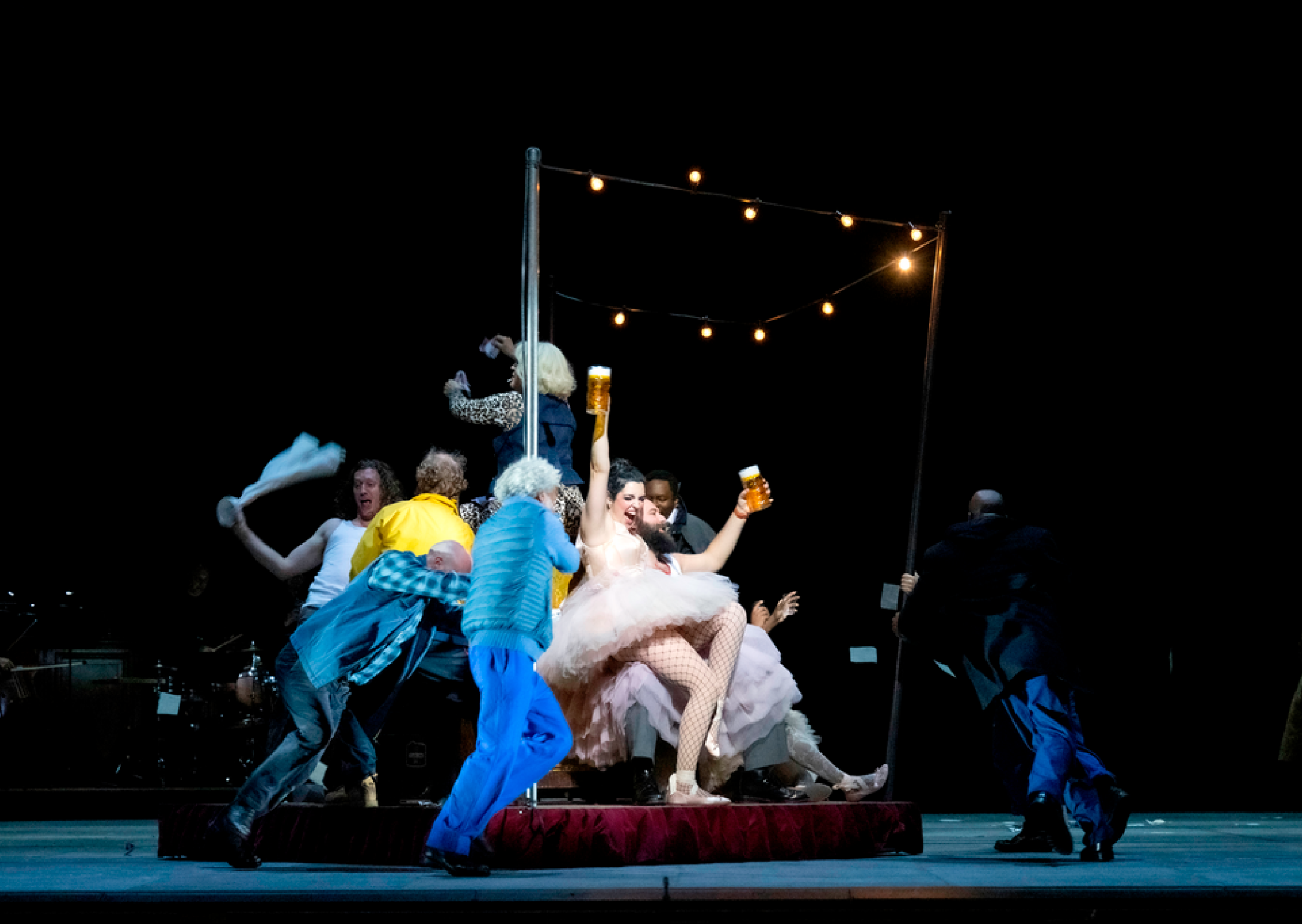
Still, it was too much to expect the Dutch National Opera to stage Grimes as it was written, in a 19th century, English port town. While the set designs by Eva-Maria van Acker were effectively dramatic and consistently simple in their suggestions, some of her costumes were not. The leopard-print blouse and leggings on Auntie, owner of ‘The Boar’ pub, were the most telltale sign that we might be in the 1980s. On the other hand, she also evoked a certain kind of post-menopausal, chain-smoking small town Dutch woman one might encounter today. Then there were Auntie’s ‘nieces’, who strutted out inexplicably in tutu’s for a salacious scene with a Methodist preacher. These costumes appeared to me as caricatures in what was otherwise an unironic production. They distracted from the seriousness of the opera, so much so that one year later, I can still remember them. Maybe that’s not a bad thing, I don’t know.
All in all, I didn’t have to pay much of a tax on Peter Grimes — at least not the first kind. I did end up paying the second tax, the cursed sort my friend was warning me of.
My dates came and went without opera and without incident. But not long after Peter Grimes, my four year-old black toy poodle suddenly became paralyzed in his hind legs. I took him to the hospital in the middle of the night. The next morning they put him through a CT scan and discovered a major hernia in his lumbar spine, and subsequently operated, promising a full recovery. We went home.
He never recovered. Over the course of the week he suffered through an ascending paralysis, losing control of both his hind and front legs, his vocal cords, and ultimately his ability to breathe. The vets at the hospital did not believe me when I described his symptoms. They were so fixated on their initial diagnosis that they refused to revise his recovery plan or schedule him for further examination. He died in my arms on 28 October, 2024, 6 days after Peter Grimes closed.
After my dog’s death I was so ridden with guilt about having left him alone at home at any point in the last, healthy weeks of his life that I swore off attending the opera for a long time. And after Peter Grimes, my guilt was all the more painful, because I had actually enjoyed it, basking in the tortured sound of a man’s guilt over the death of another.
References:
Crabbe, George. ‘Letter 22: The Poor of the Borough - Peter Grimes’ from The Borough (1810). Accessed via https://www.ourcivilisation.com/smartboard/shop/crabbeg/borough/
Roling, Laura. ‘Stage director Horáková and tenor Issachah Savage on Peter Grimes’, Nationale Opera & Ballet (1 March 2024). https://www.operaballet.nl/en/articles/stage-director-horakova-and-tenor-issachah-savage-peter-grimes
Veld, Nanno Klaas Charles Arie in ‘t. De Ereraden voor de kunst en de zuivering van de kunstenaars: Een bijdrage tot de geschiedschrijving van de zuivering van het vrije beroep. Staatsuitgeverij 1981.
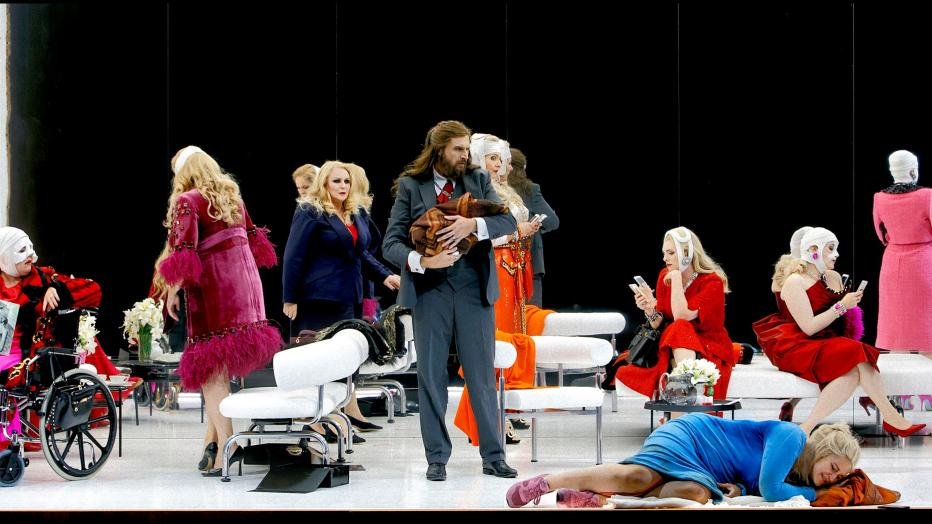
Die Walküre, Bayreuther Festspielehaus 29.7.24
Die Walküre, Bayreuther Festspielehaus, 29.07.24
By Sigmund Oakeshott
‘Mad’ King Ludwig’s alpine festnung of glimmering stone and hair-tuggingly exuberant Rapunzel spires, all set beneath seemingly Toblerone-hewn peaks was supposedly built as a refuge from the then-on trend - and still on-trend - psuedo anarcho-iconoclasm of Munich’s liberal intelligentsia. Indeed, today Neuschwanstein endures as a case study in late 19th century gilded sword-knot twirling conservative camp, evoking flavours of a pint-sized Richard Wagner fingering his tiny dog-whip menacingly while placing fetishistic mail orders for satin-bowed costumes and corsets suspiciously in his size or his patron Ludwig leaping unconvincingly aboard Bismarck’s spike-helmeted madmoiselle-despoiling Deutsches Reich bandwagon in a fruitless quest just to secure the funds to finish his Swan-Knight pleasure palace. Given Ludwig’s breathless letters to Wagner about this cod-piece-jostlingly neo-Gothic bachelor pad Susanna Puente Matos and our heroically tracht-clad travelling party thought we should pay our respects there before trundling North to Bayreuth via an arcane timetable of charming if circuitous Bavarian regional trains which evidenced in particularly teutonic terminology why it was Prussia and not the fairytale dirndl-domain surrounding us that became the dominant German power.
Our point is that you don’t need to be thunder-clapped in Norwegian fjord to see there’s enough transgression inherent to both the composer - oddly never yet featured on any ‘Refugees Welcome Here’ graphics despite his years in Swiss exile - and to his horse-master-obsessed regal funding-source to make Bayreuth edgy enough without having to resort to thrusting the fleshy forearms of tonight’s Aussie conductrice into the audience’s faces via the mirrored glass of the 1980s leisure-centre-like like set. We could touch on all we saw in this staging of Die Walkure beyond the distorted chamber-of-orchestral-horrors shattered-looking-glass-like reflections of the first violins in their jogging bottoms and soiled t-shirts, but so antithetical was it to both Wagner’s gesamtkunstwerk ideal of the transcendental opera experience, more so even than the Virtual Reality glasses inflicted on us last year, so removed was it from the actual plot of the Ring Cycle, that one wondered whether this was secretly all some long-running Post-War West German in-joke whose punch-line escaped us.
There were the young children in gold-sequined thigh-highs, more glam-rock than Gotterdammering, standing in variously for the Rheingold, the Tarhelm, the Ring, each traded between increasingly rich and sleazy 1970’s upper-crust foster parents. Tomasz Konieczny’s Wotan was powerfully sung star turn, too noble to come off as predatory as the director had rewritten the part. Christa Mayer’s Fricka was majestically horrid, enough to send Catherine Foster’s petulant Brunnhilde off into the arms of Bader-Meinhof-esque earthly suitor, as the staging appeared to suggest. There was the illuminated pyramid with a pistol inside it, half didactic elementary school light prism experiment and half post-modern ironic depiction of a Jagdschloss-set coup plot. I slowly suspected this may be just the sort of daring new repertoire the Munich anarcho-iconoclast opera-establishment really wanted to stage - ‘The Prince, the Judge and the ex-Paratroop Regiment Commander’. Could there be a better named Baritone baddie than Heinrich XIII? But I digress.
Doomed instead to stage The Ring Cycle twice a summer for eternity, Bayreuth’s programme screamed philosopher Theodor Adorno’s 1967 rhetorical question: ‘What does Wotan want?’ - ‘The end’. Certainly this year’s Ring, with its orchestra on view , its bushwhackingly irreverent conductor Simone Young, Valentin Schwartz’s direction ranging from the madcap foetus-on-film opening of Wotan and Alberich as twins separated as birth to Sieglinde molested by her godly grandfather in a dingy stairwell and Brunnhilde being subject to a fatherly chokeing before stalking off backstage in huff, could be almost be re-dubbed ‘Springtime for Wagner’. Borrowing from Mel Brook’s Producers plotline, I was sure some fifth column of malign geniuses in the Bayrisches Staatsministerium fur Wissenschaft und Kunst must have had the intention all along of staging a Ring Cycle so repellent, so drably non-sensical, that they could finally cast off the shackles of the paradisal Siegfried Idyll or the Panzer-rolling, Huey-gunship chuddering theme of the Walkurenritt and ‘de-chronologise and decolonise’ - in the words of one interval grandstander - the Bavarian opera canon for good.
Suddenly much more sympathetic to King Ludwig’s fantastical plan to escape from his cultural commentariat to an unaffordable, unrealisable chivalric chateau in the sky, I resolved to seek solace in one’s closed eyelids, happily remembering the lederhosen-burstingly sweaty hike up to Neuschwanstein. As the orgiastic flutes and violins of the final ‘Magic Fire Music’ swept me away in blissful darkness, I reflected I hadn’t, in this Vienna University Philosophy grad’s retelling, actually seen what had happened to Brunnhilde, but presumed true to form, she must have been chained in a dank basement by her father instead of set triumphally on some flame-licked summit. I also missed the conductor’s bow, but then - and man hath no greater insult to Wagner’s than this, the mystique of having the maestro hidden behind Wagner’s specially designed obscuring wooden lip, had long since been stolen, like the magic of the Rheingold, from us by the Tik-Tok like mirrored gimmickry of the set. A strobe-lit Twilight of the Gods, flashing aggravatingly still in one’s mind’s eye.
By Sigmund Oakeshott
‘That artistic director. What a douche. This doesn’t count as my first time - as far as I’m concerned I’m still a Valkyrie virgin’ protested an elegant brunette as the curtain fell on the opening night of Valentin Schwarz’s retelling of Die Walküre on Monday.
‘Cherie, the last Bayreuth production I came to was so bad, the conductor cried when it was over’ a veteran Wagnerian of Parisienne extraction offered by way of consolation, while processing like a stately galleon to the Biergarten, unlit Gauloise already in hand. Not so much a dramatic nadir then, as a sub-oceanic trench, perhaps beholding through the fug, leagues above, the dimly gleaming hull of a half-serviceable Fliegander Hollander production of yesteryear. Which beggared the question, as we sat nursing our steins of Kellerbier, shadowed by the bulk of the Bayreuther Festpielehaus; from what dramatic heights, what soaring historic feats of artistic refinement, have such present operatic depths been plumbed?
It brought to mind the example of Neuschwanstein, ‘Mad’ King Ludwig’s alpine Festung of glimmering stone and hair-tuggingly exuberant Rapunzel spires. Supposedly built as a refuge from the then-on trend - and still on-trend - psuedo anarcho-iconoclasm of Munich’s liberal intelligentsia and set beneath Toblerone-worthy snow-dusted peaks, this much-Disney-parodied castle endures as a case study in late C19th sword-knot twirling conservative camp. It evokes flavours of a pint-sized Richard Wagner fingering his equally-tiny dog-whip menacingly while correcting fetishistic mail orders for satin-bowed costumes and corsets all suspiciously in his size.
The dressing-up-closet nose of the place: of perfumed silk and compact powder - is slightly offset by menacing undertones of moustache-wax and brass polish - the historic reek of Wagner’s patron Ludwig leaping despondently aboard Bismarck’s spike-helmeted madmoiselle-despoiling bandwagon in a fruitless quest to fund said Swan-Knight pleasure palace.
Given Ludwig’s breathless accounts of his neo-Gothic never-finished bachelor pad in letters to his Lucerne-bound tremolo-terrorist chum - Wagner being a terror in both a musical ‘destroy-Mendelssohn-and-Mayerbeer’ manner and in a literal, ‘Saxon-court-just-sentenced-your-fellow-revolutionaries to death’ sense, Susanna Puente Matos and our heroically tracht-clad schloss-to-trot travelling party felt obliged to pay our respects therein. The piece de la resistance, is, naturlich the arcaded baronial-style balcony, jutting out god-like over the forested valleys below - on our visit yawning under the weight of several bovine Dutch beauties. Squeezed between their ample busts and bingo-wings, dodging the lances of their extended iphone-tripod legs, one only had to mentally paint a bit of chainmail coif on to them to get a sense of what the historic Brunnhildes of Bayreuth-yore might have reassembled. Yet there was little need for such reverie, because if you really want to see shield-maidens with selfie-sticks, all you need do is try your luck at any contemporary Der Ring production and I’ll wager you’ve an even chance.
Trundling slowly north to Bayreuth- accompanied by snippets of Gergiev’s 2012 Marinsky Parsifal wafting from our mini-Bose over deserted platforms - via an arcane timetable of charming if circuitous and oft-delayed Bavarian regional trains, we reflected why it was that grain-alcohol-and-goosestepping Prussia, and not the fairytale vine-hung florid-dirndl-demesne surrounding us, had became the dominant German power. But the real nub of it all is that you don’t need to be thunder-clapped in Norwegian fjord (as Wagner once was fleeing from his debtors in Riga) to see that there’s enough in the way of transgression and personal-flaws inherent to both the composer - oddly never yet featured on any ‘Refugees Welcome Here’ graphics despite his years in Swiss exile - and to his horse-master-fancying regal funding-source to make Bayreuth edgy enough without having to resort to thrusting the fleshy forearms its maestro into the audience’s faces via the mirrored glass a 1980s leisure-centre-like set.
We could touch on all we saw in Monday’s staging of Die Walküre beyond the distorted chamber-of-orchestral-horrors looking-glass reflections of its kaftan-clad conductor or the First Violins in their jogging bottoms and soiled t-shirts. Yet so antithetical was it to both Wagner’s Gesamtkunstwerk ideal of the transcendental opera experience - more so even than the VR glasses inflicted on us last year - so removed was it from the actual plot of Der Ring, that one wondered whether this was secretly all some long-running esoteric Neue Deutsche Welle in-joke whose punch-line escaped us.
There were the young children in gold-sequined thigh-highs, more glam-rock than Gotterdammering, standing in variously for the Rheingold, the Tarhelm, the Ring, with each traded between increasingly rich and sleazy 1970’s West German upper-crust foster parents. Tomasz Konieczny’s Wotan was powerfully sung star turn, too noble to pass-off as the predator the director had rewritten him as. Christa Mayer’s Fricka was majestically, indomitabily stern, enough to send Catherine Foster’s petulant Brunnhilde off into the arms of a roguishly Bader-Meinhof-worthy earthly suitor. There was the illuminated pyramid with a long-barrelled Luger inside it, half didactic elementary school light prism experiment and half post-modern depiction of an all too convincing Jagdschloss-set coup plot.
I slowly suspected these contemporary references might suggest just the sort of daring new repertoire the aforementioned Munich anarcho-iconoclast opera-establishment really wanted to stage - ‘The Prince, the Judge and the ex-Paratroop Regiment Commander’ - I mean, could there be a better named ready-made Baritone baddie than Heinrich XIII? But I digress.
Doomed instead to stage The Ring Cycle twice a summer for eternity, Bayreuth’s programme was emblazoned with philosopher Theodor Adorno’s 1967 declaration: ‘What does Wotan want?’ - ‘The end’.
Certainly this year’s Ring, with its orchestra on view , its bushwhackingly irreverent conductor Simone Young and willy-waiving direction from Valentin Schwartz; from the madcap foetus-on-film opening of Wotan and Alberich as twins separated at birth to Sieglinde molested in a dingy stairwell and a leather-tasselled Brunnhilde being subjected to a fatherly choking before stalking anti-climatically offstage in a huff, could all be summed up as ‘Springtime for Wagner.
What an inspired repurposing of Mel Brook’s The Producers plot-line, cryptically also of 1967 vintage! I was sure some fifth column of malign geniuses in the catchily-titled Bayrisches Staatsministerium für Wissenschaft und Kunst must have had the intention all along of staging a Ring Cycle so repellent, so drably non-sensical, that they could cast off the shackles of the paradisal Siegfried Idyll or the Panzer-tread-clinking, Huey-gunship chuddering soundtrack of the Walkürenritt and finally ‘de-chronologise and decolonise’ - in the words of one interval grandstander - the Bavarian opera canon for good.
Suddenly much more sympathetic to King Ludwig’s fantastical plan to escape from his cultural commentariat to an unaffordable, unrealisable chivalric chateau in the sky, I resolved to seek solace in one’s closed eyelids, happily remembering the previous morning’s lederhosen-burstingly sweaty hike up to Neuschwanstein. As the orgiastic flutes and violins of the closing ‘Magic Fire Music’ swept me away in blissful darkness, I reflected I hadn’t, in the present Vienna University Philosophy grad Herr Schwarz’s retelling, actually seen what punishment befell Brunnhilde. Presumably something suitably niederöstereichisch -perhaps chained in a dank basement by her father instead of set triumphally on a flame-licked peak? I also missed the conductor’s bow, but then - and man hath no greater insult to the composer than this - the age-old Bayreuth mystique of having the maestro hidden behind Wagner’s specially designed obscuring wooden lip, had long since been stolen, like the magic of the Rheingold itself, by the sub-Tik-Tok mirrored gimmickry of the set. A strobe-lit Twilight of the Gods, flashing aggravatingly still in one’s mind’s eye.

Fidelio, Dutch National Opera 23.06.24
by Susana Puente Matos
Andrij Zholdak’s production of Fidelio for the Dutch National Opera was so terrible it may or may not have cost me a burgeoning relationship. I don’t know. The last I heard was that he was going offline and had absconded to the woods.
The opera hung over our dates like a storm cloud, although of course I was blissfully unaware of this. I had bought the tickets months and months before I had even met him. They seemed perfectly harmless: two central second-row orchestra seats for a Sunday matinee which couldn’t be longer than two and a half hours, including intermission. This wasn’t Wagner. This was Singspiel, and Beethoven, and one of opera’s finest overtures.
June was busy and I wasn’t reading Dutch news, so I didn’t know that Zholdak was booed off the stage after the opening performance, Ukrainian flag above his head be damned. An email sent by the opera house to ticketholders the day before my matinee was the first I heard of near-unanimous one-star reviews in the press. The email read:
Many reviews state that it was difficult to follow director Andrij Zholdak’s vision during Fidelio. Because we want to make sure that visitors better understand what they will see during the performance, we recommend that you read the information page on our website.
Uh oh. I clicked the link and started reading Hein van Eekert’s explanation of the production. “There are two issues that seem to make this production complicated,” he began:
1. Director Andrij Zholdak replaced the dialogue with his own dialogue (and removed part of the music, but that does not affect the storyline)
2. The director left the libretto to the musical parts intact. The words to the music are now meaningless.
So there was a new, spoken, surrealist storyline in English wrapped around the original sung, 18th century-Spain storyline in German. I stared at the ceiling and sighed; stopped reading and shut my computer.
The next day we cycled to the opera house under a rare blistering Dutch sun. Already the tides were turning on this excursion: I wanted bad weather for a matinee, not terrasje weer, as the Dutch say. What set designs could compete with boat-watching along a glistening canal under the shade of an elm tree? I stopped breathing every time we climbed a canal bridge, fearful that my Manolos would explode from the pressure of pushing down on the bicycle peddles. Surely they were not made for this.
The overture would sustain us through whatever Zholdak had done with the opera, I thought to myself as we settled into our seats. I tried to remain optimistic. Then a low-resolution projection flashed against the closed curtains on stage: INTERNATIONAL COSMIC DAY SPACE CONFERENCE, it read, (“cosmic” in pink). My cheeks burned with embarrassment. Soprano Jacquelyn Wagner approached the podium in a pink suit. Three men sat with their backs toward the audience in cheap plastic chairs to her right. In an affected, Twin Peaks monotone, Wagner said something about a black hole nearing the earth. I twisted my wrist in my hand. Where was the overture? The budget cosmic conference ended and a movie screen rolled down showing Wagner stepping into a cab through extremely close up, Peep Show style shots. I shifted awkwardly in my seat. There was still no music.
We watched Wagner go to church, then to bed with Florestan, whereupon she was introduced as his wife Leonore. A portly man carrying a snake crept through the mirror in their bedroom and ushered Florestan back through with him, leaving the snake on an arm chair. Leonore woke up to discover her husband gone. She rushed to the mirror. After fifteen interminable minutes, the conductor raised his baton and began to quell the rising tides of embarrassment within me by at last commencing the overture.
But there was so much happening on stage during the overture that it was reduced to soundtrack: Leonore left to put on a red, Dora the Explorer back pack for her school trip to hell. Effete Satyrs popped out of grottos hauling rolling mirrors on and off stage. Demons (?) waltzed about with crumpled wings, as if they had been stored poorly and the costume team had no time to iron them out. I was so busy trying to make sense of what was going on and whether any of it could possibly be important enough to distract from the overture that I hardly heard the music at all.
Zholdak inserted so much of his own dialogue that the total run time of the opera, including intermission, was three hours rather than the normal two and a half. At some point Zholdak robbed us of several precious minutes of sunshine by forcing us to watch in silence as a robot-man glacially traversed the stage for no obvious reason. An insertion of Beethoven’s third symphony was wasted on a scene change – more rolling mirrors. I pitied the singers, whipping out fuzzy wolf masks and setting things on fire, as if their hard-trained voices and Beethoven’s music were not enough.
I gave up and retreated into my own thoughts. I recalled a visit to Vienna in May 2023, when Sigmund Oakeshott and I decided to skip out before the curtains rose on the Goldberg Variations set to modern dance at the Wiener Statsoper. We feared having the image of thumping, fleshy dancing emblazoned on our retinas forever whenever the Variations would be performed. What was more important: our money or Bach’s music? We made a dash for Sacher Torte instead.
I tuned back in just in time for the closing of Act I. Nobody clapped. At intermission I asked my guest if he wanted to leave. We debated it until the bell chimed for reentry.
“What time is it?”
He checked his watch. “Three-thirty. When does it end?”
“Five,” I said.
“An hour and a half more...” he drifted off, glancing courageously in the direction of our seats.
The last time I had seen Fidelio was a decade earlier, on December 10, 2014 at La Scala in Milan. At the very last minute before curtains rose, it was announced that Florestan would be performed by a stand-in, Jonas Kaufmann. I will always remember his voice piercing the silence of the hall from his prison pit in Act II. His voice had something of metal and earth in its outer tin and inner warmth. Gott! Welche Dunkel hier. I remember complaining about the costumes: dreary, grey-toned and timeless. I retract this complaint after Zholdak’s Fidelio. They didn’t distract from the music.
Less than a week after the disastrous opera, I’m relieved at how much of it I have already forgotten. A small part of me regrets leaving, since I now wonder how much damage forgettable productions can inflict. But I didn’t want to witness Florestan sing that aria for no reason. Nor did I want to scare my guest off opera forever. I worry about the other newcomers in that theater who felt obligated to see it through to the end. I hope they will return to the opera, consoled by the improbability of seeing something worse.
As for my date, even though we did leave early it was probably already too late. The experience might have triggered a sensory overload, forcing him into radical retreat. Perhaps Zholdak’s Fidelio did penetrate an Ur-Germanic chord of Beethoven’s opera. What could be more German, after all, than inspiring one’s audience to go offline and embark on a Jüngerian Waldgäng?
Carmen, Metropolitan Opera 22.05.24
Cracknell’s “Feminist” Carmen at the Metropolitan Opera
By Susana Puente Matos
For her debut at the Metropolitan Opera, British theater director Carrie Cracknell decided to interpret Bizet’s history-changing, grand opéra comique through what she called a “feminist lens.”1 In her Carmen, this boils down to an eschewal of blood-soaked realism. The opera opens with military being called in to break up not a knife fight between Carmen (mezzo Soprano Clementine Margaine) and fellow factory workers, but a hair-tugging cat fight. At the production’s end, Carmen isn’t stabbed to death by her jealous, deadbeat lover, the deserter-turned-smuggler Don Jose (tenor Michael Fabiano). Rather she is bludgeoned with a baseball bat. The single whack swung by Don Jose is even accompanied by a nifty sound effect that goes plock! when the wood hits Carmen’s temple, as if her head were empty.
Is depriving the tragic heroine of blood – either causing bloodshed or shedding it herself – feminist? I pondered this as Don Jose haplessly clung to his clumsy, phallic weapon. I wondered why Cracknell didn’t opt for a gun. If a feminist lens wasn’t going to save Carmen, that majestic wolf, then for Bizet’s sake, I thought, at least let her die in the face of a more formidable force.
At the very least, the decision to kill Carmen with a Three Stooges bat and not a pistol suggests that Cracknell’s “feminist lens” is not a desperate attempt to be relevant. For if it were, she would have no doubt used the opportunity to shed light on the gun violence which wracks the United States. But she didn’t. Guns are tastefully employed in Cracknell’s Carmen for the sole purpose of sounding alarms.
When Carmen died for the first time in Paris in 1875, it sparked a scandal. “Quelle verité,” one critic wrote of Carmen shaking her hips, “mais quelle scandale.”2 The scandal was not that she was murdered per se. As the opera goer well knows, opera heroines have been crushed, shot, poisoned, strangled and drowned in sacks; they have wasted away from illnesses both physical and mental.3 In 2013 Cracknell directed Berg’s Wozzeck at the English National Opera, which ends with Wozzeck stabbing his wife Marie, before killing himself.
The scandal rested in the fact that in being murdered, Carmen became exotic, real and tragic when she wasn’t supposed to be. She was the heroine of an opéra comique, the lighter counterpart to the heftier grand opéra and the ancestor of the modern-day musical. In choosing Prosper Merimée’s novella Carmen (1845) as his libretto, Bizet intended to shock his audiences who expected lighter,more frivolous fare. Just as Gershwin and Bernstein deepened the genre of the musical to include more complex harmonies and gritty, realistic plotlines in the 20th century, so too did Bizet expand the opéra comique in the 19th, transforming it into a genre that could move one to tears and joy, all at once. He did this by democratically bestowing equal attention to all parts, from the close harmonies of the soldiers to the dramatic, tension-ridden motif of his roguish heroine.4 The stately Carmen became the favorite opera of Queen Victoria, Otto von Bismarck, Nietzsche, and James Joyce.5
Cracknell’s production did not evoke tears. It opens with a flock of pink-frocked women fluttering past men in cargo pants to begin their day in a weapons factory. The pink uniform seems by now to have become an obligatory tribute to Greta Gerwig’s Barbie (hadn’t I just seen them at Jay Scheib’s Parsifal at Bayreuth in 2023?). I had to squint through the dark at my program to confirm that the opera was set in today’s mid-western America, and not in Ukraine or Outer Space.
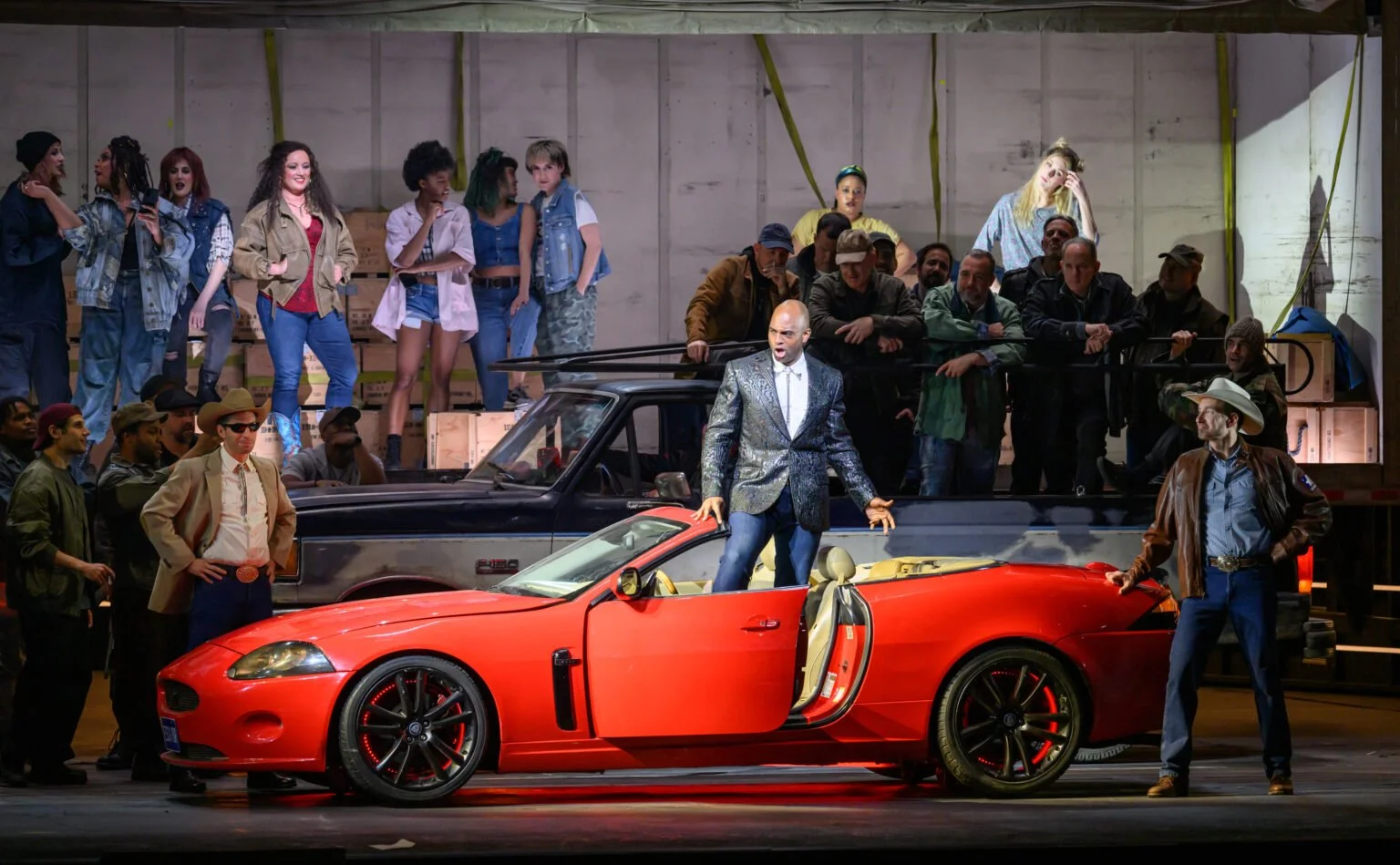
I wondered whether Cracknell had ever been to the mid-west. As if to compensate for this lacuna in her visual portfolio, set designer Michael Levine staged all of Act II in a Star-Wars warp highway (lighting by Guy Hoare). The audience chuckled as more and more cars were packed onto the stage – first a six-wheeler, then a pickup, then a red convertible carrying the rodeo bull rider Escamillo (bass-baritone Ryan Speedo Green). Was this Carmen we were watching, or a sad parking-lot tribute to Herzog’s Fitzcarraldo?
The challenge of making an opera relevant for a contemporary audience has far less to do with affecting change than it does with acknowledging continuity. For the individual opera goer of 1875, a woman’s murder was as shocking then as it is now. It does not matter whether they filed it under the current label of “femicide.” The Met’s most recent production of Carmen suggests a failure to recognize this. Consequently, Carmen’s murder became a mockery. Through its vague, shapeless suggestion of the mid-west, bloodless conflicts and curve-murdering costumes by Tom Scutt, Cracknell’s production robs Carmen of the bloody, passionate tragedy which once made it so revolutionary. It pushes it back to the opéra comique’s standard of farce Bizet had once so magnanimously surmounted.
A week before seeing Carmen, a friend and I had been exchanging stories about farms, where both of us had witnessed the violence of reproduction. In Ecuador a cousin waxed poetic about the strength of their dairy farm’s bull sperm imported from Spain. I then watched, flinching, as an employee plunged his fist holding a sperm-filled rod upwards into a cow’s vagina amid a mess of blood and fluids and mooing and muck. My friend, meanwhile, had worked on a farm in Montana with real bulls. She told me how, one day, she saw a bull penetrate a large, stoic cow. He pounded into her so forcefully and for so long that the cow collapsed from exhaustion. Still the bull wouldn’t stop. The farmhands had to intervene. They tore the bull off the cow to prevent him from killing her.
Perhaps such experiences should be prerequisites for understanding gritty, real heroines like Carmen. Her strength lies not in her ability to escape death, but in her tenacity to laugh in the face of it. To deny reality is not feminist. It’s delusional, and potentially dangerous. It certainly doesn’t service an opera like Carmen.
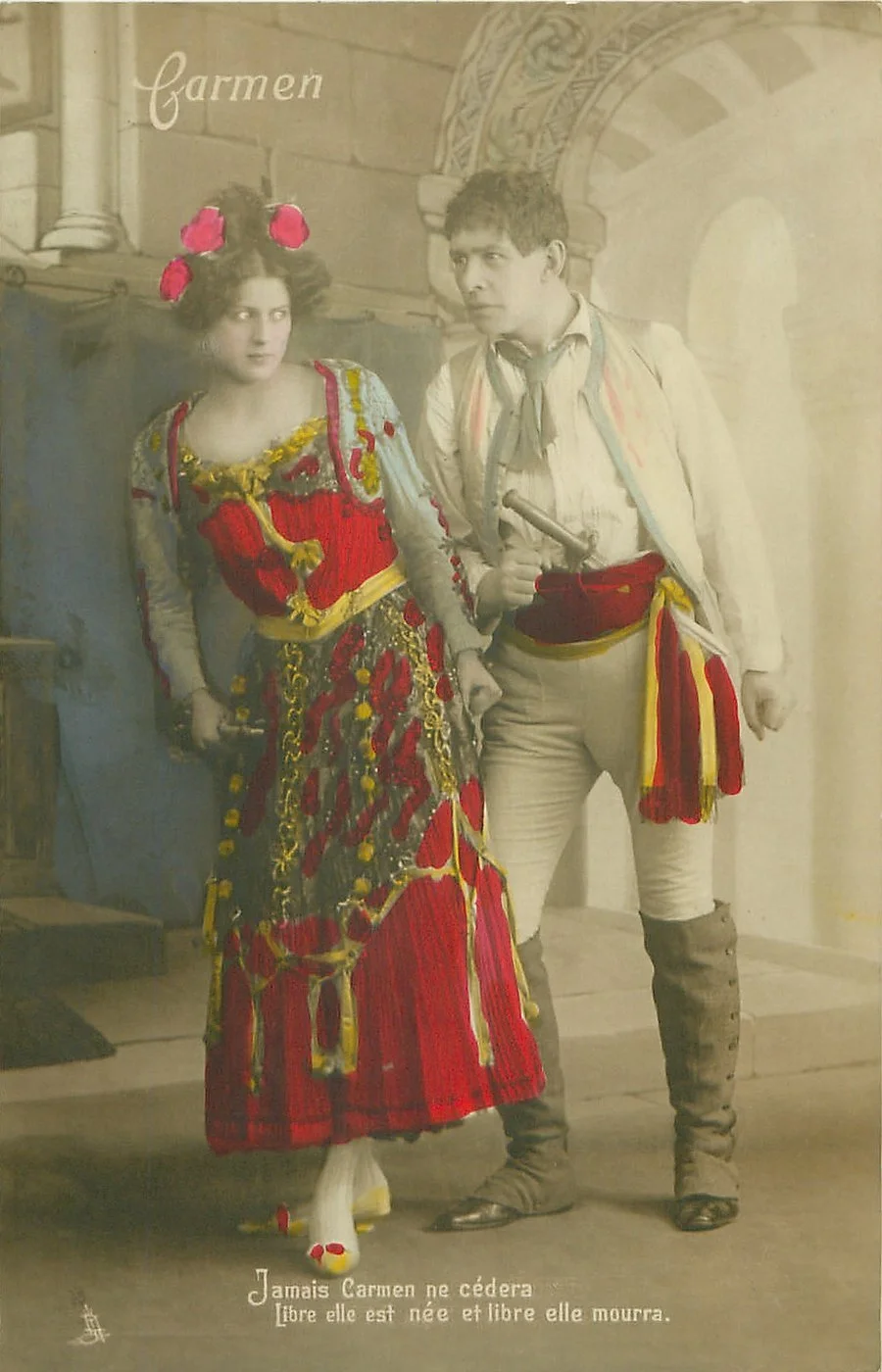
“Jamais Carmen ne cédera,” she declares before Don Jose’s knife, chin held high. “Libre elle est née et libre elle mourra!”
1 Ed. Matt Dobkin, “Fearless. Unconventional. Daring.” The Metropolitan Opera. Accessed May 30, 2024. < https://www.metopera.org/discover/articles/fearless.-unconventional.-daring/>
2Édouard Noël and Edmond Stoullig, Les Annales du théâtre et de la musique, Première année 1875 (Paris, 1876), p. 108. Cited in Carolyn Abbate and Roger Parker, A History of Opera (New York: W.W. Norton & Company, 2012), p. 334.
3 Abbate and Parker, A History of Opera, p. 333.
4 Ibid p. 317.
5 Ibid, p. 334.
By Susana Puente Matos
For her debut at the Metropolitan Opera, British theater director Carrie Cracknell decided to interpret Bizet’s history-changing, grand opéra comique through what she called a “feminist lens.” In her Carmen, this boils down to an eschewal of blood-soaked reality. It opens with the military being called in to break up not a knife fight between Carmen (mezzo-soprano Clémentine Margaine) and fellow factory workers, but a hair-tugging cat fight. At the production’s end, Carmen isn’t stabbed to death by her jealous, deadbeat lover, the deserter-turned-smuggler Don Jose (tenor Michael Fabiano). Rather she is bludgeoned with a baseball bat. The single whack swung by Don Jose is even accompanied by a nifty sound effect that goes plock! when the wood hits Carmen’s temple, as if her head were empty.
Is depriving the tragic heroine of blood – either causing bloodshed or shedding it herself – feminist? I pondered this as Don Jose haplessly clung to his clumsy, phallic weapon. I wondered why Cracknell didn’t opt for a gun. If a feminist lens wasn’t going to save Carmen, that majestic wolf, then for Bizet’s sake, I thought, at least let her die in the face of a more formidable force.
At the very least, the decision to kill Carmen with a Three Stooges bat and not a pistol suggests that Cracknell’s “feminist lens” is not a desperate attempt to be relevant. For if it were, she would no doubt have used the opportunity to shed light on the gun violence which wracks the United States. But she didn’t. Guns are tastefully employed in Cracknell’s Carmen for the sole purpose of sounding alarms.
When Carmen died for the first time in Paris in 1875, it sparked a scandal. “Quelle verité,” one critic wrote of Carmen shaking her hips, “mais quelle scandale.” The scandal was not that she was murdered. As the opera goer well knows, opera heroines have been crushed, shot, poisoned, strangled and drowned in sacks; they have wasted away from illnesses both physical and mental. In 2013 Cracknell directed Berg’s Wozzeck at the English National Opera, which ends with Wozzeck stabbing his wife Marie, before killing himself.
The scandal rested in the fact that in being murdered, Carmen became exotic, real and tragic when she wasn’t supposed to be. She was the heroine of an opéra comique, the lighter counterpart to the heftier grand opéra and the ancestor of the modern-day musical. In choosing Prosper Merimée’s novella Carmen (1845) as his libretto, Bizet intended to shock his audiences who expected lighter, more frivolous fare. Just as Gershwin and Bernstein deepened the genre of the musical to include more complex harmonies and gritty, realistic plotlines in the 20th century, so too did Bizet expand the opéra comique in the 19th, transforming it into a genre that could move one to tears and joy, all at once. He did this by democratically bestowing equal attention to all parts, from the close harmonies of the soldiers to the dramatic, tension-ridden motif of his roguish heroine. Carmen became everyone’s favorite opera, from Queen Victoria, to Otto von Bismarck, to Nietzsche, to James Joyce.
Cracknell’s production did not evoke tears. It opens with a flock of pink-frocked women fluttering past men in cargo pants to begin their day in a weapons factory. The pink uniform seems by now to have become an obligatory tribute to Greta Gerwig’s Barbie (hadn’t I just seen them at Jay Scheib’s Parsifal at Bayreuth in 2023?). I had to squint through the dark at my program to confirm that the opera was set in today’s mid-western America, and not in Ukraine or Outer Space.
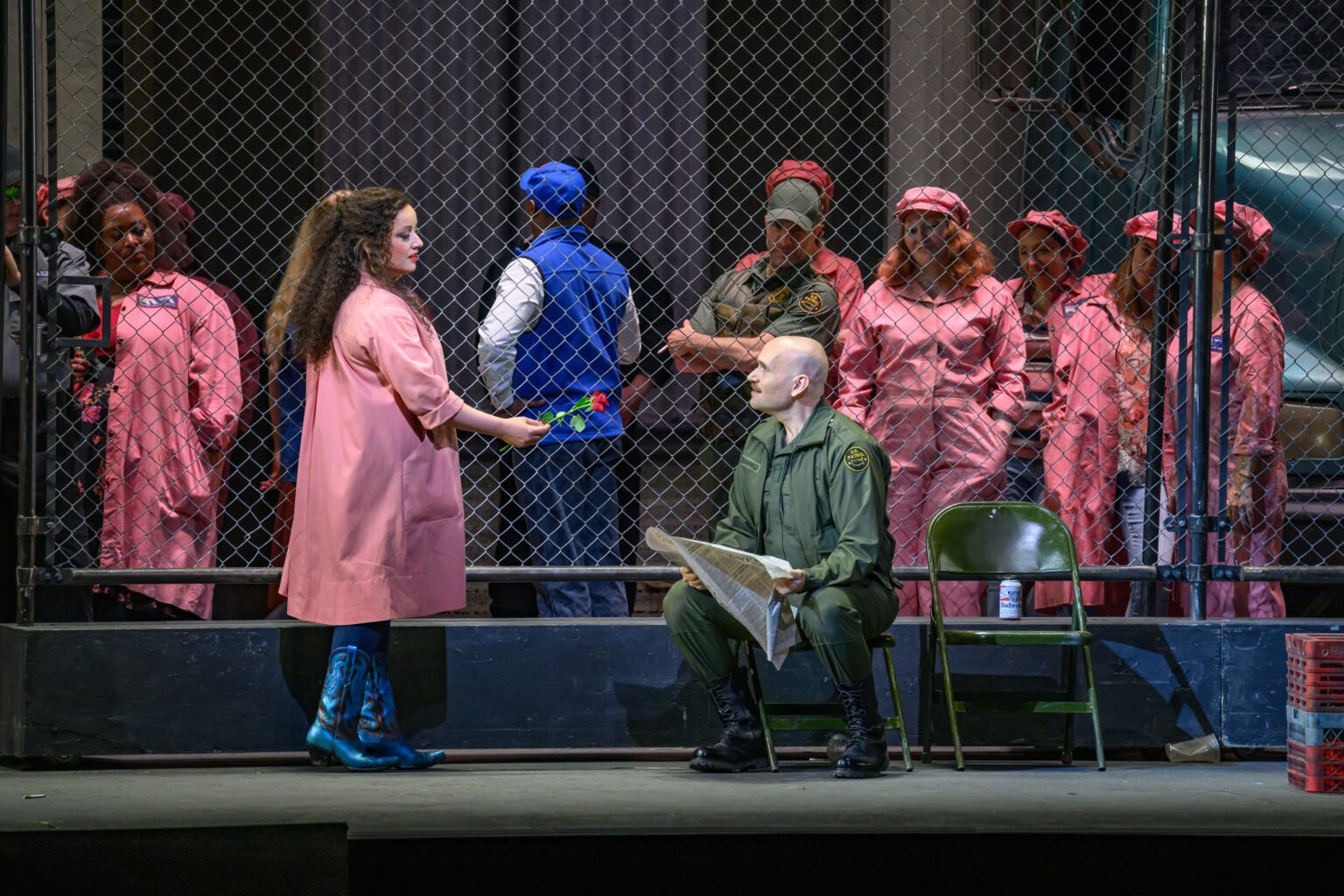
Clémentine Margaine and Michael Fabiano (Photo Nina Wurtzel)
I wondered whether Cracknell had ever been to the mid-west. As if to compensate for this lacuna in her visual portfolio, set designer Michael Levine staged all of Act II in a Star-Wars warp highway (lighting by Guy Hoare). The audience chuckled as more and more cars were packed onto the stage – first a six-wheeler, then a pickup, then a red convertible carrying the rodeo bull rider Escamillo (bass-baritone Ryan Speedo Green). Was this Carmen we were watching, or a sad parking-lot tribute to Herzog’s Fitzcarraldo?
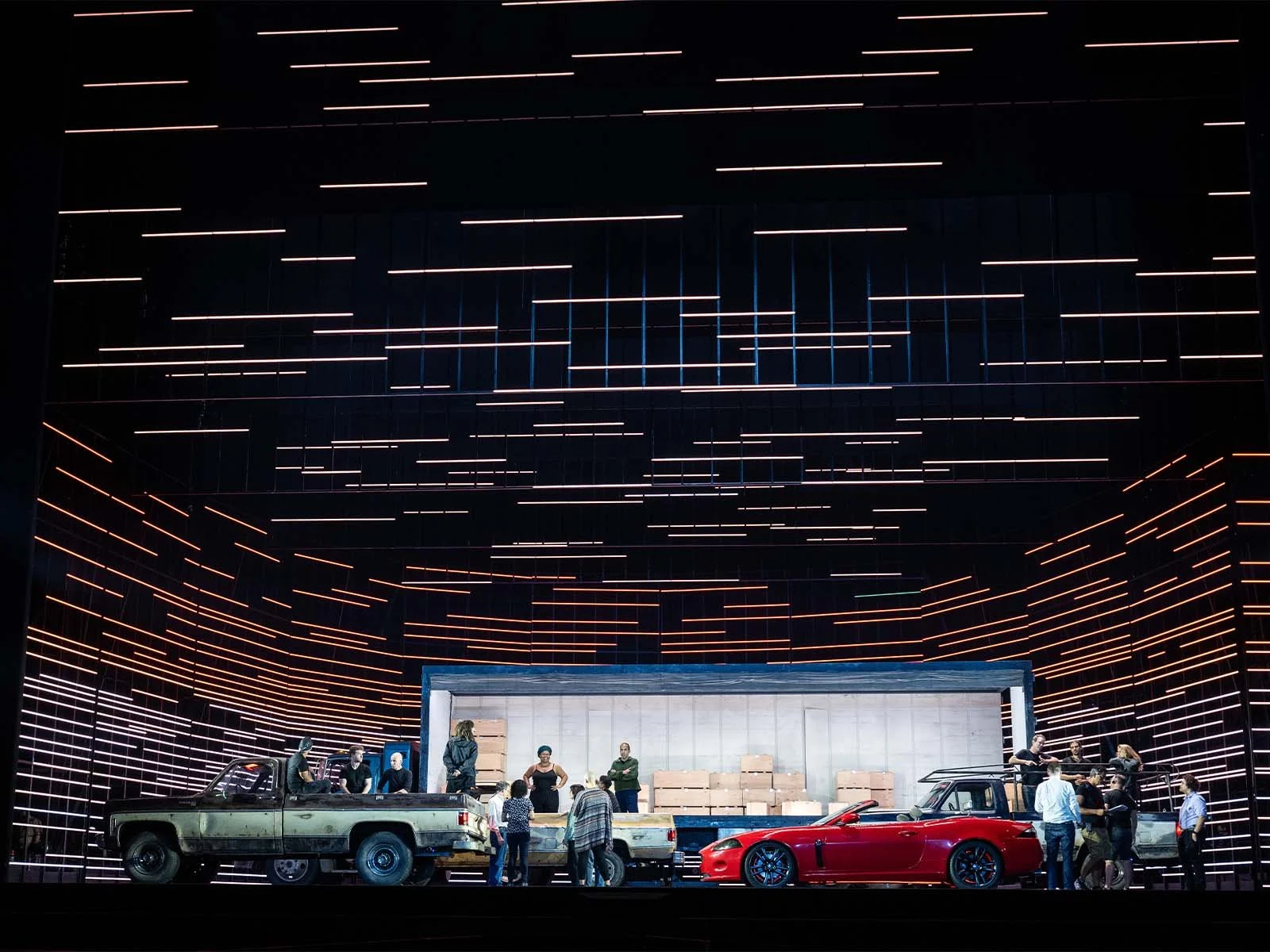
Taken during a technical rehearsal. (Source: Metropolitan Opera)
The challenge of making an opera relevant for a contemporary audience has less to do with affecting change than it does with acknowledging continuity. For the individual opera goer of 1875, a woman’s murder was as shocking then as it is now. It does not matter whether they filed it under the current label of “femicide.” The Met’s most recent production of Carmen suggests a failure to recognize this. Consequently, Carmen’s murder became a mockery. Through its vague, shapeless suggestion of the mid-west, bloodless conflicts and curve-murdering costumes by Tom Scutt, Cracknell’s production robbed Carmen of the bloody, passionate tragedy which once made it so revolutionary. It pushed it back to the standard of farce Bizet had once so magnanimously surmounted.
A week before seeing Carmen, a friend and I had been exchanging stories about farms, where both of us had witnessed the violence of reproduction. In Ecuador a cousin waxed poetic about the strength of their dairy farm’s bull sperm imported from Spain. I then watched, flinching, as an employee plunged his fist holding a sperm-filled rod upwards, like a lance, into a cow’s vagina, amid a mess of blood and fluids and mooing and muck. My friend, meanwhile, had worked on a farm in Montana with real bulls. She told me how, one day, she saw a bull penetrate a large and stoic cow. He pounded into her so forcefully and for so long that the cow collapsed from exhaustion. Still the bull wouldn’t stop. The farmhands had to intervene. They tore the bull off the cow to prevent him from killing her.
Perhaps such experiences should be prerequisites for understanding gritty, real heroines like Carmen. Her strength lies not in her ability to escape death, but in her tenacity to laugh in the face of it. To turn away from reality is not feminist. It’s delusional, and potentially dangerous. It doesn’t service an opera like Carmen.
“Jamais Carmen ne cédera,” she cries before Don Jose’s knife, chin held high. “Libre elle est née et libre elle mourra!”
References:
Interview with Carrie Cracknell, edited by Matt Dobkin, “Fearless. Unconventional. Daring.” The Metropolitan Opera. Accessed May 30, 2024. < https://www.metopera.org/discover/articles/fearless.-unconventional.-daring/>
Carolyn Abbate and Roger Parker, A History of Opera (New York: W.W. Norton & Company, 2012)
Die Meistersinger von Nürnberg, Teatro Real 14.5.24
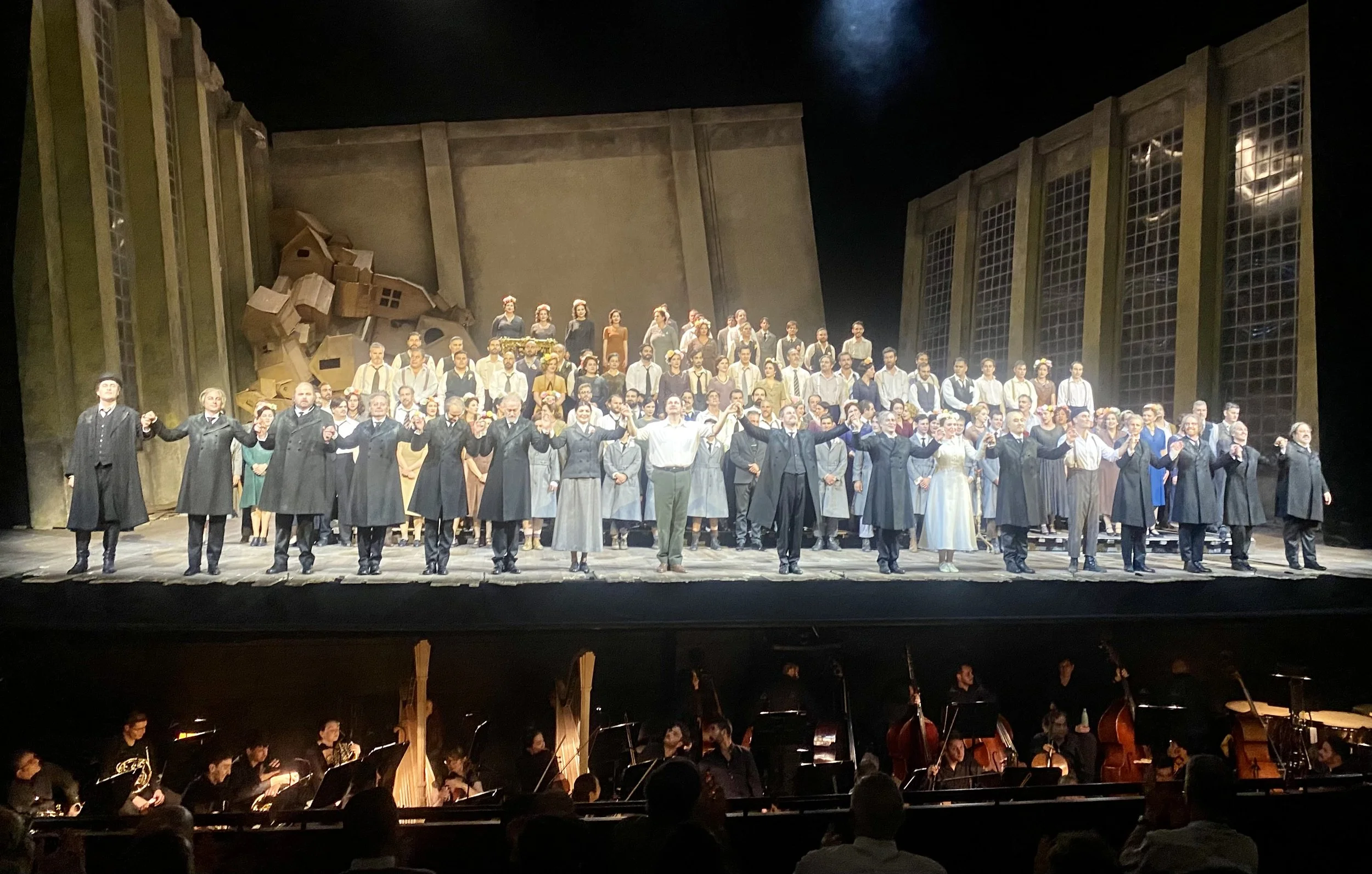
An elegant stream of Madrilènos flowed out from under the great grey-columned bulk of the Teatro Real on Tuesday, so exhilarated by the conducting of Pablo Heras-Casado as to have given the cast of Die Meistersinger von Nürnberg an eleven-minute standing ovation. The sheer teutonic brawn of the hundred-strong chorus, amplified by the Teatro’s state-of-the-art acoustics and tempered by the majestically-slow baton-work of Heras-Casado seemed to move the audience to a state of semi-rapture . I last saw the Andalusian conductor conjure up his dark magic at Bayreuth in August with Parsifal. Just as the sub-par staging there of a post-Apocalyptic VR-enhanced Monsalvat was redeemed by the sheer bliss of the closing Chorus Mysticus, here in Madrid Laurent Pelly and Caroline Ginet’s muddled backdrops and gender-bending costumery were figuratively drowned-out by the meadow-set legion belting out their final praises of tragi-hero Franconian cobbler Hans Sachs. Hans was powerfully portrayed by Canadian baritone Gerard Finley, still amply-lunged at 64 and utterly convincing in noble widower / german romantic nationalist guise, as perhaps Wagner saw himself after the death of his first wife Minna.
Sadly the character of Walther von Stolzing, roving-Junker turned convert to the cause of German-craftsmanship and the other crucial male protagonist was played by tenor Tomislav Muzek whose upper registers and flabby gait seem to lack that quintessential Wagnerian virility so essential to Die Meistersinger. Nichole Chevalier’s Eva was adeptly sung. Die Meistersinger having been composed in the 1860s after both Wagner’s disastrous Parisian Tannhauser ballet dalliances and a failed stab at staging Tristram… in Vienna, the role of Eva is unusually lyric and was well suited to the clarity of Chevalier’s voice.Jongmin Park's Pogner was a fine fit also to his dramatic, booming bass voice. The hapless Sixtus Beckmesser, well-sung if played with slightly overdone comic villainy by baritone Leigh Melrose, spent the first two acts in an inexplicably plaster-stained frock coat and by the third act was leering, post-beating, beneath full joker-like make-up. The extended quintet set in Hans Sach's Nuremberg workshop as the Christen the new song'Selig wie die Sonne meines Gluckes lacht' was of particular note for how sublimely it was sung, Heras-Cacado keeping the brass stately but subdued.
The set throughout was fenced off by 1930s architecture, confusingly evoking more the swimming pool of the Berlin Olympiad than anything of artistic substance while the crucial final meadow scene became instead an ersatz Berchtesgaden, a painted backdrop of soaring Bavarian Alps before which non-binary styled bands of singers clustered around in drab trenchcoats.
One began wondering if the director Pelly had ever laid eyes on the Pegnitz river which snakes so lethargically like a muddy-brown serpent uncoiled into heart of Franconia - Wagner’s setting for the Meistersingers’ final Third Act contest. Erroneously shoehorning on an oversaturated melange of snow-capped peaks and Gestapo-esque flasher macs rendered the whole mis-en-scene like some sort of disturbingly volkisch home movie, hardly helped by Hans Sach’s final exhortations to shake off the ‘foreign mists and foreign vanities they would plant in our land’ and to ‘live in the honour of the German masters.’ Indeed, given the political leanings of the Madrid, one pondered whether the last few minutes of manic applause might as much be for the slightly problematic sentiments of the work as for the strength of the performance.
More effective was the setting for the Second Act, perhaps betraying the hand of the master set-builders of the Royal Danish Opera, with whom this was a co-production. Dozens of card-board-built mediaeval merchant houses, church spires and squat castle bastions adorned the stage, huddled on top of one another. These not only reassembled the hulking mass of Nuremberg as depicted in Albrecht Durer woodcuts, but as the characters wove between them, serenading windows and making midnight trysts, captured the sense of curtain-twitching neighbours and the stifling 16th century social mores that bound both Eva and Hans to share only a platonic passions.
In sum then, the excellent orchestral work under the measured pacing of Heras-Cacado matched with the powerful Schopenhaueren pathos of Finley’s Hans Sachs triumphed over the suspect staging and disorientating costumal affections of what was a still bizarrely compelling production of Die Meistersinger.
⭐️⭐️⭐️⭐️
By Sigmund Oakeshott
An elegant stream of Madrilènos flowed out from under the great grey-columned bulk of the Teatro Real on Tuesday, so exhilarated by the conducting of Pablo Heras-Casado as to have given the cast of Die Meistersinger von Nürnberg an eleven-minute standing ovation. The sheer teutonic brawn of the hundred-strong chorus, amplified by the Teatro’s state-of-the-art acoustics and tempered by the majestically-slow baton-work of Heras-Casado seemed to move the audience to a state of semi-rapture . I last saw the Andalusian conductor conjure up his dark magic at Bayreuth in August with Parsifal. Just as the sub-par staging there of a post-Apocalyptic VR-enhanced Monsalvat was redeemed by the sheer bliss of the closing Chorus Mysticus, here in Madrid Laurent Pelly and Caroline Ginet’s muddled backdrops and gender-bending costumery were figuratively drowned-out by the meadow-set legion belting out their final praises of tragi-hero Franconian cobbler Hans Sachs. Hans was powerfully portrayed by Canadian baritone Gerard Finley, still amply-lunged at 64 and utterly convincing in noble widower / german romantic nationalist guise, as perhaps Wagner saw himself after the death of his first wife Minna.
Sadly the character of Walther von Stolzing, roving-Junker turned convert to the cause of German-craftsmanship and the other crucial male protagonist was played by tenor Tomislav Muzek whose upper registers and flabby gait seem to lack that quintessential Wagnerian virility so essential to Die Meistersinger. Nichole Chevalier’s Eva was adeptly sung. Die Meistersinger having been composed in the 1860s after both Wagner’s disastrous Parisian Tannhauser ballet dalliances and a failed stab at staging Tristram… in Vienna, the role of Eva is unusually lyric and was well suited to the clarity of Chevalier’s voice.Jongmin Park's Pogner was a fine fit also to his dramatic, booming bass voice. The hapless Sixtus Beckmesser, well-sung if played with slightly overdone comic villainy by baritone Leigh Melrose, spent the first two acts in an inexplicably plaster-stained frock coat and by the third act was leering, post-beating, beneath full joker-like make-up. The extended quintet set in Hans Sach's Nuremberg workshop as the Christen the new song'Selig wie die Sonne meines Gluckes lacht' was of particular note for how sublimely it was sung, Heras-Cacado keeping the brass stately but subdued.
The set throughout was fenced off by 1930s architecture, confusingly evoking more the swimming pool of the Berlin Olympiad than anything of artistic substance while the crucial final meadow scene became instead an ersatz Berchtesgaden, a painted backdrop of soaring Bavarian Alps before which non-binary styled bands of singers clustered around in drab trenchcoats.
One began wondering if the director Pelly had ever laid eyes on the Pegnitz river which snakes so lethargically like a muddy-brown serpent uncoiled into heart of Franconia - Wagner’s setting for the Meistersingers’ final Third Act contest. Erroneously shoehorning on an oversaturated melange of snow-capped peaks and Gestapo-esque flasher macs rendered the whole mis-en-scene like some sort of disturbingly volkisch home movie, hardly helped by Hans Sach’s final exhortations to shake off the ‘foreign mists and foreign vanities they would plant in our land’ and to ‘live in the honour of the German masters.’ Indeed, given the political leanings of the Madrid, one pondered whether the last few minutes of manic applause might as much be for the slightly problematic sentiments of the work as for the strength of the performance.
More effective was the setting for the Second Act, perhaps betraying the hand of the master set-builders of the Royal Danish Opera, with whom this was a co-production. Dozens of card-board-built mediaeval merchant houses, church spires and squat castle bastions adorned the stage, huddled on top of one another. These not only reassembled the hulking mass of Nuremberg as depicted in Albrecht Durer woodcuts, but as the characters wove between them, serenading windows and making midnight trysts, captured the sense of curtain-twitching neighbours and the stifling 16th century social mores that bound both Eva and Hans to share only a platonic passions.
In sum then, the excellent orchestral work under the measured pacing of Heras-Cacado matched with the powerful Schopenhaueren pathos of Finley’s Hans Sachs triumphed over the suspect staging and disorientating costumal affections of what was a still bizarrely compelling production of Die Meistersinger.
Lohengrin, Nationale Opera 11.11.23
Have you ever wandered beneath the glass-awnings of Covent Garden Market, bombarded the busker-bel canto of a sub-par soprano, and fantasised about what it might be like to a have a some nordic Royal Opera House Lyrischersopran singing a Wagner aria to you in unspecified imaginary shopping centre instead? Well as I foundout to my cost, the private pique of fantasising about such things, is rarely matched by reality when said fantasy is finally acted out, with or without consequences for one's marriage... I should disclose here, my only real qualification for reviewing any opera at all is that my wife (and me by extension) share a conducting coach with Cate Blanchett, oh, and of course Granny's stories of 1930s Bayreuth, but I digress.
Take yourself off to the soulless glass and steel city hall - cum - opera of Amsterdam, and you really can see Malin Bystrom, the best Swedish Salome since Birgit Nilson, sing in an edifice, which to all intents and purposes, both aesthetically and acoustically speaking, reassembles suburban mall. Lohengrin opened this week at the so-called 'StOpera' a portmanteau of 'stadhuis' and 'opera', under the rather hard-driving baton of Lorenzo Viotti, a boy-band-handsome thirty something, cosplaying (for the first act at least) as a pre-Riefenstahl Furtwangler. The shimmering strings of the Prelude, drawn-out to spar so expressively with the brass, showed flashes of Viotti’s ability to conjure up the sublime.The Swiss impressario’s baton darted imperiously, but with a loose approach to tempo and dynamics, surely surprising and delighting even the acoustically-bereft Amsterdam audience, forced to hear Wagner in such unsatisfactory surrounds.This is apparently Viotti’s swansong (if you’ll forgive the Lohengrin double entendre), having chosen not to renew his contract with the ‘StOpera’. His predecessor Marc Albrecht saw out his stint with Tristan und Isolde five years ago, and an insider of my acquaintance remarked that ‘if you try to leave the Nationale Opera, the ‘men in grey suits’ force a Wagner number on you as final demand, usually with a stripped down set - it’s the best money-spinner they can think of before one goes on to better things.’
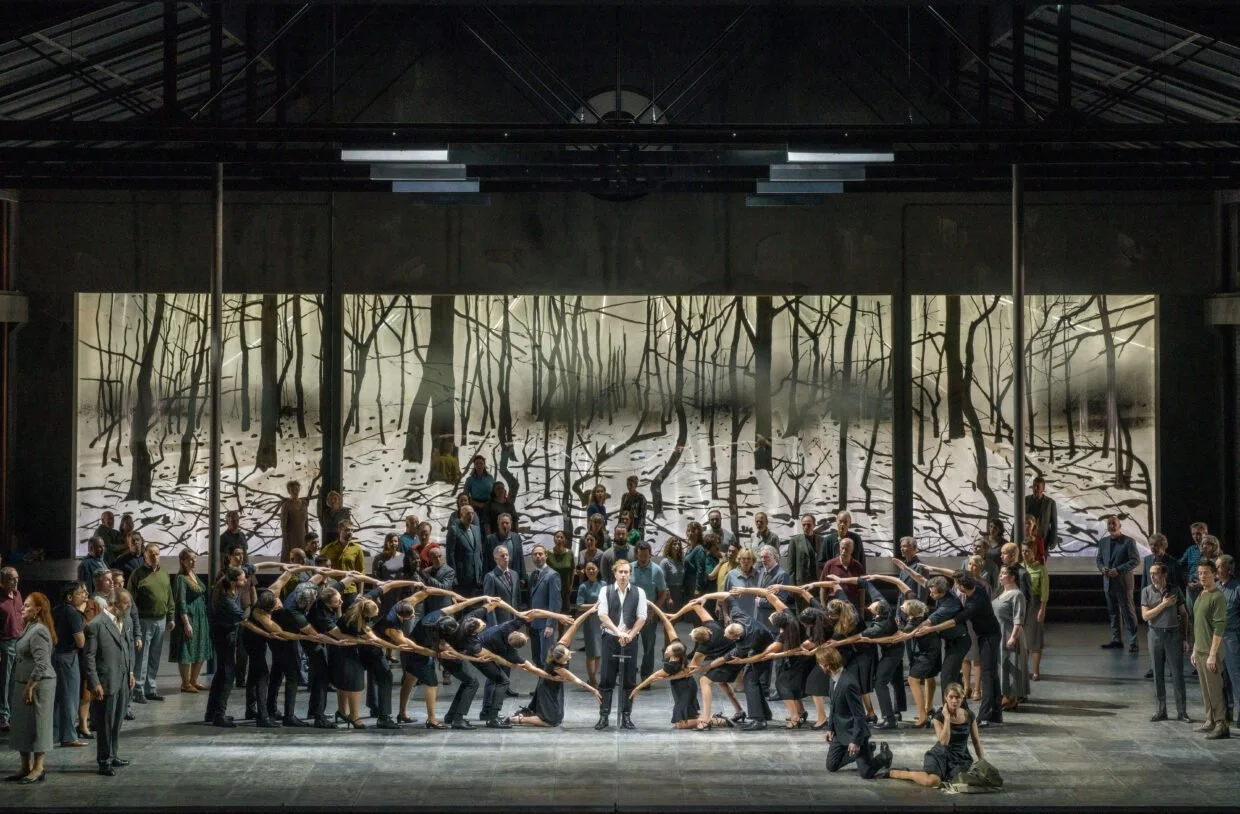
Indeed, men in grey suits are much evident here, supposedly the gay array of the militia of Brabant mustered by the fanfare horns of the Holy Roman Emperor Henry the Fowler. Though suspiciously this chorus in their drab tailoring look much like the hunting party from Act II the 2018 production of Tristan. Christof Loy’s direction denudes the stage of little more than a garage door, punctuated by the occasional overlay of spindly black trees. A few rather brauny dancers popped out at the start of Act II, and other than their girations the only other visual to help orientate the narrative is said dancers forming a human daisy chain to suggest some sort of serpentine form that might be interpreted wings of a swan. Combined with the distinctly 80’s environs, one begins to feel trapped in some past-its-sell by date West German experimental theatre productions, with only the sudden schmaltz of Treulich Gefurth (Viotti too appeared to have lost all passion by this point) to break the spell.